
By the DEALSisHERE Senior Product Review & Affiliate Content Team | Last Updated: June 27, 2026
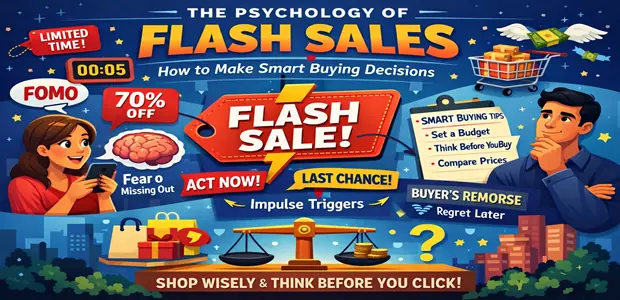
Flash sales are everywhere in 2026 — countdown timers, “only 3 left” warnings, and red banners screaming 70% off. They feel exciting. They’re designed to. Understanding the psychology of flash sales is the single most valuable skill a modern online shopper can develop, because the difference between a genuinely good deal and an impulsive overspend is almost never about the discount percentage. It’s about whether you were in control of the decision.
This guide breaks down exactly how flash sale mechanics work, when they represent real value, and how to build a personal decision framework that protects your budget without making you miss the deals that actually matter.
📩 Join the DEALSisHERE Insider Network — Insulate your budget from predatory conversion funnels. Get non-manipulated pricing data, infrastructure audits, and fully authenticated discount streams delivered straight to your inbox. Subscribe Now →
Quick Verdict
Flash sales are not inherently bad. Some represent genuine clearance opportunities with real savings. Many do not. The problem isn’t the discount — it’s the interface design engineered to prevent you from thinking clearly. Once you understand the three core manipulation triggers and have a simple personal checklist, you can evaluate any flash sale in under five minutes and make a decision you won’t regret.
What Flash Sales Actually Are
A flash sale is a time-limited promotional event where a retailer offers significant discounts — typically 20% to 80% — on a select range of products for a short window, often 24 hours or less.
They originated in e-commerce as a tool for clearing excess inventory. Gilt, Woot, and Groupon built entire business models around the format in the early 2010s. By 2026, the flash sale has evolved into a sophisticated conversion optimization tool used by virtually every major retailer — Amazon’s Lightning Deals, Temu’s countdown offers, ASOS’s flash events, and countless others.
The core mechanics haven’t changed. The psychological engineering behind them has become significantly more precise.
How Flash Sale Psychology Actually Works
Trigger 1: Scarcity and Loss Aversion
Human brains are wired to assign higher value to things perceived as rare or disappearing. Behavioral economists call this loss aversion — the pain of losing something feels roughly twice as powerful as the pleasure of gaining something equivalent.
Flash sales weaponize this directly. “Only 2 left at this price” doesn’t just inform you of stock levels. It reframes the decision from “should I buy this?” to “can I afford to miss this?” That’s a fundamentally different cognitive state, and it’s one where rational price comparison becomes very difficult.
What to watch for: Inventory counters that fluctuate erratically on page refresh, or that reset suspiciously. Genuine clearance has stable, declining stock numbers.
Trigger 2: Time Compression
A visible countdown timer — especially one accurate to the second — creates what psychologists call temporal discounting on steroids. The tighter the deadline, the more your brain devalues future options (like waiting, checking elsewhere, or simply sleeping on it) relative to the immediate action in front of you.
This is the same mechanism that makes auction bidding feel electric. It’s not a coincidence. The interface is engineered to produce that specific neurological state.
What to watch for: Timers that reset when you reload the page, or “flash sales” that have been running for several days. A genuine time-limited offer has a fixed, verifiable end point.
Trigger 3: Social Proof Engineering
“Yusuf from Ankara just bought this.” “47 people are viewing this right now.” These notifications are not informational — they are social pressure tools. They simulate herd behavior and trigger competitive validation: if everyone else is buying it, it must be worth buying.
In many cases, these notifications are algorithmically generated estimates rather than real-time data. Some platforms have faced regulatory scrutiny for fabricating them entirely.
What to watch for: Social proof notifications that appear generic, don’t reference verifiable information, or arrive at suspiciously timed intervals.
The Real-World Pros of Flash Sales
When approached with discipline, flash sales offer genuine advantages.
Legitimate clearance pricing. Retailers do need to move old inventory. End-of-season apparel, previous-generation electronics, and discontinued product lines often appear in flash sales at prices that reflect genuine cost reductions — not manufactured urgency.
Discovery of brands you wouldn’t otherwise find. Flash sale platforms, particularly in fashion and home goods, regularly feature smaller brands at accessible price points. This can be genuinely valuable for buyers willing to research the brand independently.
Real savings on planned purchases. If you already know you need a specific product and have researched its price history, a flash sale that brings it to or below its historical low is an objectively good buying opportunity. The manipulation tactics are irrelevant if you’ve already done your homework.
Budget-friendly entry into premium categories. Legitimate flash sales on quality goods can bring otherwise unaffordable items within reach — particularly in cookware, audio equipment, and fitness gear, where brand premiums are high but physical quality differences between tiers are meaningful.
The Real-World Cons of Flash Sales
Inflated “original” prices. One of the most documented issues in flash sale retail is reference price manipulation. A product listed at “was $200, now $80” may have been sold at $90 routinely. The $200 anchor exists solely to make $80 feel like a bargain. Regulatory bodies in the EU and UK have increasingly challenged this practice, with ASOS, Boohoo, and others facing enforcement action.
Quality ambiguity. Flash sales frequently move products that have been difficult to sell for a reason — poor reviews, quality control issues, or inferior specifications. The time pressure discourages thorough review-reading.
Impulse purchases with high return friction. The urgency that drives the purchase evaporates the moment the item arrives. Return processes can be deliberately cumbersome, particularly for international orders from low-cost platforms.
Data and security risks. High-velocity promotional events are also prime hunting grounds for phishing replicas — fraudulent sites mimicking legitimate retailers. See our guide: How to Spot a Fake Online Store: The Anatomy of a Shopping Scam.
Comparison Table: Genuine Deal vs. Manufactured Urgency
| Feature | Genuine Flash Sale | Manipulative Flash Sale |
|---|---|---|
| Price History | At or below 180-day historical average | Price spiked 7–14 days before the “sale” |
| Inventory Counter | Stable, consistently declining | Fluctuates on page refresh |
| Countdown Timer | Fixed end time, doesn’t reset | Resets on reload or has been “live” for days |
| Social Proof | Absent or minimal | Constant notifications (“X just bought this”) |
| Product Reviews | Verified, balanced, product-specific | Thin, generic, or suspiciously timed |
| Checkout Process | Standard, secure, familiar platform | Sudden redirect to unknown third-party |
| Return Policy | Clearly stated, accessible | Buried, restrictive, or absent |
| Post-Purchase Feeling | Satisfied — matches planned need | Regret — driven by the timer, not the need |
Who Should Engage With Flash Sales?
Planned buyers who’ve already researched. If you’ve been tracking a specific product, know its price history, and the flash sale brings it to a genuine low — buy it. This is the flash sale working as intended.
Shoppers with defined budgets and lists. Buyers who enter flash sale events with a specific, pre-written list and a hard spend ceiling can capture real value without the impulse risk.
Bargain hunters with flexible timelines. If you’re not in a hurry and can afford to wait for the deal to be verifiable — cross-checking price history before committing — flash sales reward patience.
Who Should Skip Flash Sales?
Anyone shopping without a specific need. Browsing a flash sale without a predefined shopping list is a near-guarantee of impulse spending. The interface is engineered for exactly this scenario.
Buyers on tight budgets. The psychological pressure is most dangerous when you have limited financial buffer. A “great deal” on something you didn’t need is still money you didn’t intend to spend.
Anyone unable to verify price history first. Without a tool like Keepa (Amazon), CamelCamelCamel, or a browser extension like Honey, you cannot verify whether the “sale price” is actually a discount. If you can’t verify it, skip it.
International shoppers on unfamiliar platforms. High-pressure flash sale environments are significantly riskier on platforms you haven’t used before, particularly when shipping internationally and return logistics become complex.
Value For Money Analysis: The 5-Minute Flash Sale Audit
Before any flash sale purchase, run this checklist. It takes under five minutes and has an extremely high success rate at filtering genuine deals from manipulation.
Step 1 — Isolate the net cash outlay. Ignore the “original price” anchor completely. Write down only what you’re actually being asked to pay. Then ask: “Would I buy this at this price if there were no countdown timer and no ‘X% off’ banner?” If the answer is no, stop here.
Step 2 — Check price history. Use Keepa for Amazon products. Use Google Shopping price history for others. If the current “sale price” is not at or near the product’s historical low, the discount is likely manufactured.
Step 3 — Enforce a 24-hour hold. Add the item to your cart and close the window. Come back tomorrow. If the deal is gone, assess honestly: do you feel relief or regret? Genuine need produces regret. Impulse produces relief.
Step 4 — Verify the platform. Confirm you’re on the legitimate retailer’s domain. Check the URL carefully. Confirm the checkout uses a recognized secure payment method with buyer protection.
Step 5 — Read the return policy before purchasing. If the return window is under 14 days or requires international shipping at your cost, factor that into the real price.
Alternatives Worth Considering
If flash sales feel too high-pressure, these alternatives consistently deliver genuine value without the psychological engineering:
Price tracking tools. Keepa and CamelCamelCamel automatically alert you when specific Amazon products hit your target price. No urgency, no timers — just data.
Cashback platforms. TopCashback, Rakuten, and similar services layer additional savings on top of regular prices. Over a year, cashback on planned purchases frequently outperforms impulse flash sale savings.
Retailer loyalty programs. Many major retailers offer early access to genuine sales events for loyalty members, without the public-facing urgency mechanics.
Refurbished and certified pre-owned markets. For electronics especially, certified refurbished products from manufacturer-approved sellers frequently offer better long-term value than flash sale new units.
📦 Amazon Daily Promo Codes → — Cross-reference your shopping list against active merchant promotional codes and verified real-time price drops without the countdown pressure.
🇨🇳 AliExpress Strategic Sourcing Hub → — Source accessories and hardware directly from factory-origin suppliers and bypass domestic retail markup layers.
Frequently Asked Questions
Q: Are flash sales ever actually worth it?
Yes — when you’ve already researched the product, verified its price history is at or near a genuine low, and the purchase meets a real, pre-existing need. The issue isn’t flash sales themselves; it’s making purchase decisions driven by the timer rather than the product’s value to you.
Q: How do I check if a flash sale price is actually a discount?
For Amazon products, use Keepa or CamelCamelCamel — both show the full price history graph for free. For other retailers, Google Shopping often shows price history. Browser extensions like Honey can also surface historical price data at checkout automatically.
Q: Is the “only X left in stock” warning real?
Sometimes. On established platforms like Amazon, low-stock warnings are generally tied to real inventory data. On smaller or less regulated platforms, these figures can be fabricated or artificially managed. If the counter fluctuates up and down on refresh, treat it as a manipulation signal.
Q: What should I do if I regret a flash sale purchase?
Act immediately. Most consumer protection frameworks give you 14 days for online purchases in the EU and UK, and similar rights exist in many other jurisdictions. Check the return policy, initiate the return process as soon as possible, and document everything in writing. For credit card purchases, chargeback protection is available if the seller doesn’t honor their stated returns policy.
Q: Are flash sales on platforms like Temu or SHEIN safe?
The platforms themselves are generally functional for low-cost goods, but carry specific risks: shipping timelines are long, quality is inconsistent, and return processes can be cumbersome for international buyers. The flash sale mechanics on these platforms are particularly aggressive. Apply the 5-minute audit above with extra scrutiny, and never enter payment details on a site you accessed via a social media ad link without independently verifying the URL.
Final Verdict
Flash sales are a legitimate retail mechanism that has been heavily engineered for psychological manipulation. That doesn’t make them automatically bad — it makes them something you need to approach with specific tools and a clear head.
The buyers who consistently win in flash sale environments are not the fastest clickers. They’re the ones who already knew what they wanted, had already verified the price was fair, and happened to find it on sale. The countdown timer was irrelevant to their decision.
Build your shopping list before you browse. Know your target prices before the sale starts. Verify price history before you commit. And when in doubt, enforce the 24-hour hold. The deal that disappears overnight was probably never the deal it claimed to be.
Real-Time Strategic Sourcing
🚀 High-Velocity Capital Preservation & Sourcing Alerts
Stop allowing predictive e-commerce systems and flashing interface elements to manipulate your emotional state, disrupt your budget discipline, and drain your liquid reserves:
📩 Subscribe to the DEALSisHERE Newsletter → — The definitive strategic procurement and system security guide for asset-focused, high-growth digital professionals.
Affiliate Disclaimer: We may earn a commission if you make a purchase through our links, at no extra cost to you. This never influences our editorial positions — all analysis is conducted independently based on publicly available data and hands-on research.
Advertisement
Advertisement