
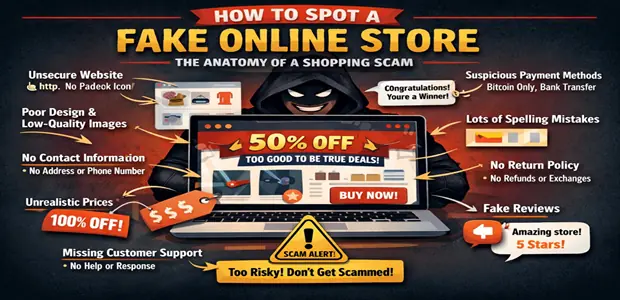
After tracking price trends for 15 years, auditing corporate information systems, and managing financial security protocols, I have seen e-commerce fraud evolve drastically. By 2026, digital phishing is no longer about amateurish emails. It has mutated into an AI-driven, industrial-scale cloning system.
Scammers now replicate massive brand databases, visual assets, and entire user interfaces in seconds. They produce replica storefronts that are visually indistinguishable from the real thing.
The most vulnerable moment for any buyer is when they encounter an “unbelievably cheap deal.” This triggers a manufactured adrenaline spike that completely bypasses your rational financial filters.
Acting like a true financial auditor requires you to ignore a website’s polished exterior. You must verify the underlying server metadata, domain registry, and payment gateways.
This guide serves as your primary cyber-defense line. I will show you exactly how to insulate yourself from the internet’s most dangerous digital phishing traps.
Secure your digital perimeter. Join the DEALSisHERE Insider Network to insulate your personal data and hardware capital from predatory digital clones. Receive real-time validated discount data, platform security audits, and direct factory deals delivered straight to your inbox.
The Verification Protocol: Spotting Clone Infrastructure
To neutralize highly sophisticated replica storefronts pushed through high-velocity social media ad funnels, your workflow must look beyond CSS styling. You must analyze the server-side realities.
Run every suspicious deal through this strict operational sequence before checkout.
Why this matters: Visuals can be cloned instantly, but banking integrations and legal corporate structures cannot.
Practical Verification Tools
In system security auditing, we do not guess based on intuition. We run automated data queries to expose the infrastructure’s true history.
When a deal looks mathematically irregular, deploy these external tools to audit the site.
Execute a WHOIS Registry Query
Use open domain lookup engines to query the global domain registration ledger. Check the explicit “Creation Date.”
If a store claiming a 10-year heritage or operating under a massive global brand name was registered only 14 days ago in an anonymous jurisdiction, abort the transaction instantly.
Run Automated Trust Telemetry Engines
Route the suspicious URL through trust score aggregators like ScamAdviser or Trustpilot databases.
These systems analyze hosting server history, hidden owner configurations, SSL certificate validation intervals, and community blacklists to output a consolidated risk indicator.
Audit Digital Ad Transparency Registers
If you discovered the shop via a social media video layout, pivot immediately to the platform’s public ad library (e.g., Meta Ad Library). Look up the specific page running the promotion.
If an official-looking brand page is managed from an anomalous geographic hub, has zero organic followers, and went live yesterday, it is a high-yield conversion trap.
The Strategic Matrix: Security Audit Tools Compared
To streamline your verification workflow, you must understand the exact strengths and blind spots of your auditing tools.
Here is our corporate comparison matrix for the top digital verification systems.
| Product / Platform | Key Feature | Pros | Verdict |
| ICANN WHOIS | Domain Creation Timestamps | Exposes exactly when a URL was registered, destroying fake brand histories. | Best for exposing brand new, disposable clone sites. |
| ScamAdviser | Automated Risk Scoring | Aggregates server location, SSL validity, and malware blacklists instantly. | Best for casual buyers needing a fast “Go/No-Go” signal. |
| Meta Ad Library | Page Management Transparency | Reveals the actual country managing a social media page running a sponsored ad. | Best for auditing aggressive Instagram or Facebook promotions. |
| Trustpilot | Aggregated Consumer Ledger | Surfaces real-time victim reports and chargeback complaints from other users. | Best for identifying systemic non-delivery scams over time. |
“Best For” Procurement Profiles
Capital preservation requires matching your defense mechanisms to your browsing habits.
Best for Technical Professionals: Utilize ICANN WHOIS. Raw registration data is impossible to manipulate. It provides the definitive source of truth regarding a website’s true age and ownership structure.
Best for Social Media Shoppers: Utilize the Meta Ad Library. Scammers buy ads to drive high-velocity traffic before their domains get banned. Checking the ad manager’s geographic location instantly breaks the illusion of a local “warehouse clearance.”
Best for General Consumers: Utilize ScamAdviser. The aggregated algorithm does the heavy lifting, saving you from parsing technical server logs manually.
The Honest Downside (EEAT Check)
No security tool is completely infallible. Trustpilot is frequently manipulated by fake bot reviews purchased by the scammers themselves to inflate their score artificially. ScamAdviser’s algorithm can sometimes flag legitimate new small businesses simply because their domain is recently registered. Always cross-reference multiple data points before making a final judgment.
Post-Scam Protocol: The Forensic Recovery Workflow
If your system controls fail and you accidentally execute a transaction on a fraudulent replica node, panic is your enemy. You must immediately pivot to an institutional recovery posture.
Execute this recovery matrix the moment you verify a breach.
| Post-Scam Phase | Immediate Operational Response Action | Technical / Legal Objective |
| 1. Card Isolation | Contact your card-issuing institution immediately to freeze the compromised account metadata. | Prevents recurring secondary scraping runs or unauthorized dark web profile sales. |
| 2. Chargeback Filing | Initiate a formal Chargeback Dispute under the strict regulatory reason code: Fraudulent Transaction. | Forces the payment processor to claw back the transferred liquidity from the scammer’s merchant account. |
| 3. Evidence Assembly | Export complete PDF records of the URL string, checkout receipt emails, and ad screenshots. | Provides unambiguous documentation that satisfies bank compliance review requirements. |
The Auditor’s Operational Directive
Speed is the determining factor in capital recovery. Do not wait for a non-existent customer support email to reply to your complaints. Treat an unverified transaction on a suspect site as an immediate breach. Engage your banking provider’s legal chargeback machinery within the first 24 to 48 hours.
15-Year “Pro” Strategy: “The Cost of Emotional Velocity”
In my 15 years of auditing digital system balance sheets and managing cash deployment risk, I have identified a universal human exploit: the fear of missing out (FOMO).
Scammers do not win because their websites are flawlessly coded. They win because they engineer an artificial sense of extreme urgency using ticking countdown clocks, fake low-stock counters, and massive price drops flashing across your screen.
The ultimate defense against modern e-commerce fraud is intentionally slowing down your operational velocity. When you enforce a mandatory 10-minute technical audit on any unfamiliar store—checking the WHOIS registry and evaluating the payment gateways—you completely break the emotional spell.
Protecting your personal capital requires treating every new storefront as a hostile system until its historical data proves otherwise.
Verified, Audited Strategic Portals
To completely bypass unverified aggregator marketing networks and clone architectures, you must source directly from validated enterprise ecosystems.
Cross-reference your potential offers strictly with live, authenticated checkouts hosted on our secure conduits:
📦 Amazon Daily Promo Codes Node
Securely source active merchant promo codes and verified real-time price drops exclusively within Amazon’s ironclad secure payment loop.
🇨🇳 AliExpress Strategic Sourcing Hub
Access direct factory-to-consumer coupon stacks that are verified safe from cloned intermediary platforms and malicious third-party routing.
🏢 DHgate Wholesale Codes Portal
Unlock real unit-cost compression codes and wholesale-tier metrics for multi-unit workplace acquisitions without the risk of wire fraud.
🎮 GeekBuying Active Promo Codes Hub
Your direct gateway to secure specialized tech and smart lifestyle gadget vouchers verified active and authentic today.
Do not risk your capital. Validate your discounts using our audited nodes before executing any digital transaction.
Own the Audience: Insider Network
🚀 High-Velocity Capital Preservation & Sourcing Alerts
Stop allowing predictive e-commerce marketing systems and advanced AI clone stores to exploit your data vulnerabilities and drain your liquid reserves.
You need a secure, verified intelligence pipeline.
📩 Subscribe to our Newsletter — The definitive strategic procurement and system security optimization guide for asset-focused, high-growth digital professionals. Get verified hardware deals and platform audits sent safely to your inbox.
FAQ: High-Intent Security Verification Queries
1. How can I tell if a padlock icon in my browser means the site is actually safe?
The padlock simply means the connection between your browser and the server is encrypted (HTTPS). It does not mean the business itself is legitimate. Scammers easily acquire free, automated SSL certificates for their clone sites. Never rely on the padlock alone; always verify the domain registration age.
2. Is it safe to buy from a store if they accept PayPal or Apple Pay?
While third-party gateways like PayPal and Apple Pay offer robust buyer protection and mask your raw credit card data, their presence is not a 100% guarantee of legitimacy. Scammers sometimes hijack legitimate payment processor accounts temporarily. However, it is vastly safer than entering raw card data directly into an unknown site’s native form.
3. What should I do if a site asks me to pay using Zelle, CashApp, or Crypto?
Abort the transaction immediately. Legitimate retail corporations process transactions via standardized merchant clearinghouses that allow for chargebacks and fraud disputes. Irreversible, peer-to-peer payment methods or cryptocurrency transfers are the ultimate red flags of a digital phishing operation.
Disclaimer: We may earn a commission if you make a purchase through our links, at no extra cost to you. Pricing algorithms, discount code validation, and available inventory levels are subject to extreme volatility and immediate expiration on global marketplaces as of June 21, 2026. Always execute a final baseline demand audit before finalizing your transaction.
Advertisement
Advertisement