
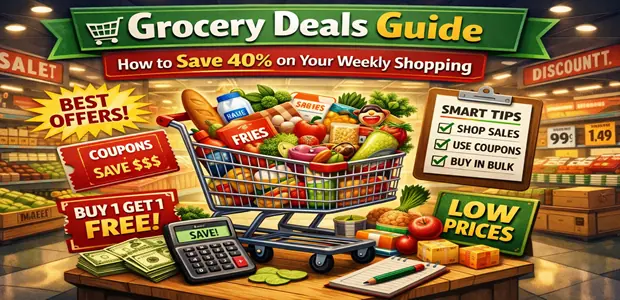
By the DEALSisHERE Senior Product Review & Affiliate Content Team | Last Updated: June 27, 2026
Grocery bills are one of the few major household expenses where consistent 20–40% reductions are genuinely achievable — without switching to lower-quality food, driving to six different stores, or spending hours clipping coupons. The savings aren’t hidden in obscure hacks. They’re buried in the gap between how supermarkets want you to shop and how a disciplined buyer actually shops.
This guide maps that gap precisely. We’ll break down the retail mechanics designed to inflate your weekly spend, the specific strategies that neutralize them, and the tools that lock in savings automatically — week after week.
📩 Join the DEALSisHERE Insider Network — Protect your household budget from algorithmic retail inflation. Get institutional-grade pricing frameworks, structural budgeting guides, and real-time strategic alerts delivered straight to your inbox. Subscribe Now →
Quick Verdict
A structured grocery shopping system — combining a pre-written list, store circular cross-referencing, unit price discipline, and cashback stacking — can realistically reduce a typical household’s weekly grocery bill by 30–40%. The approach requires roughly 20–30 minutes of planning per week. The return on that time investment is substantial: a household spending $200/week on groceries could save $3,000–$4,000 annually with consistent execution.
Why Your Grocery Bill Is Higher Than It Should Be
Before the strategies, it helps to understand what’s working against you.
Supermarkets are not neutral retail environments. They are optimized conversion machines. Store layouts, shelf placement, lighting, packaging sizes, and pricing displays are all engineered by behavioral science teams with one objective: maximize the average transaction value per visit.
The most profitable items — heavily processed, high-margin goods — are placed at eye level and at aisle end caps. Essential items like eggs, dairy, and bread are positioned at the back of the store, pulling you through as many aisles of temptation as possible to reach them.
This isn’t conspiracy — it’s documented retail science. And once you see it, you can’t unsee it.
The Three-Phase Shopping System
Phase 1: Pantry Audit Before You Leave the House
The single most impactful change most households can make costs nothing and takes 10 minutes.
Before building your shopping list, physically check your pantry, refrigerator, and freezer. Note what you already have. Build your list exclusively around what you actually need — not what you think you might need, and not what looks appealing in a store circular.
Duplicate purchases are one of the largest sources of grocery waste. Most households have a “dead zone” at the back of the cupboard — items bought a second time because the first was forgotten. That’s pure capital loss.
Practical tip: Many households find a running notes list on their phone (updated when something runs out, not when they’re already at the store) more reliable than a pre-shop audit. Use whichever method you’ll actually maintain.
Phase 2: Cross-Reference Your List Against the Weekly Circular
Every major supermarket releases a weekly promotional circular — either as a physical flyer, an app notification, or a website update. These aren’t random discounts. They’re strategically chosen loss leaders: items priced at or near cost specifically to bring you through the door.
The strategic move is to build your meal plan around what’s on promotion that week — not to force a promotional item into a meal plan you’ve already committed to.
If chicken thighs are the loss leader this week and you’d normally buy salmon, the financially optimal choice is chicken thighs. If you need salmon specifically, wait for its promotional cycle to come around.
This single habit — anchoring your meal plan to the weekly loss leader — consistently delivers 15–20% savings without sacrificing food quality.
Phase 3: Navigate the Store Architecture Deliberately
Once you’re in the store, the outer perimeter is your primary operating zone.
Fresh produce, proteins, dairy, and bread are almost universally positioned around the store’s outer edges. These are also, broadly, the most nutritionally dense and cost-effective categories of food.
Center aisles are where margins are highest and impulse purchase design is most aggressive. Enter center aisles only for specific, pre-listed items. Don’t browse.
This isn’t about being rigid — it’s about recognizing that every unplanned center-aisle item you pick up is a decision you’re making inside an environment specifically engineered to override your judgment.
The Unit Price Discipline: Reading the Label They Don’t Want You to Read
The retail price tag is almost useless for comparison purposes. The number that matters is the unit price — cost per ounce, per 100g, per sheet, per load.
In most markets, unit pricing is legally required to be displayed on the shelf label, but it’s typically in small font below the large retail price. Retailers have no financial incentive to make this easy to read.
The comparison that matters:
| Pricing Vector | The Trap | The Smart Move |
|---|---|---|
| Bold shelf price | Tells you the total cost, not the value | Ignore as a primary comparison metric |
| Unit price (per 100g/oz) | Small font, easy to miss | This is the only valid comparison number |
| “Sale” price | Anchored to a “was” price that may be inflated | Compare unit price to store brand baseline |
| BOGO promotions | Baseline price often inflated before the event | Verify unit price against non-BOGO alternatives |
| Bulk pack | Appears cheaper, but not always per unit | Calculate unit price — bulk isn’t always better |
| National brand | 30–50% premium over store brand | Store brand often identical product, same manufacturer |
The BOGO mechanic deserves specific attention. “Buy One Get One Free” sounds like a 50% discount. In practice, many retailers raise the single-unit price before initiating the BOGO event, so the effective discount is closer to 20–25%. Always calculate what you’re actually paying per unit, not what the promotional banner implies.
Real-World Pros of a Structured Grocery Strategy
Genuine, measurable savings. This is not abstract advice. A household running a structured list, cross-referencing weekly circulars, and applying unit price discipline will see reduced bills within the first week. The savings compound over time.
Reduced food waste. The average household discards roughly 30% of the perishable food it purchases. A pantry-first list-building approach directly reduces over-purchasing, which means the savings extend beyond the checkout: you’re paying for food you actually eat.
Less time in the store. A pre-written list organized by store section means a faster, more efficient shop. Households report that structured shopping trips take 20–30% less time than unstructured browsing.
Lower cognitive load. Deciding what to cook mid-week is stressful. When your meals are loosely planned around the weekly promotions in advance, that daily “what’s for dinner?” friction largely disappears.
Stacks with cashback and loyalty programs. The strategies in this guide are additive — they work alongside (not instead of) cashback credit cards, supermarket loyalty programs, and coupon apps, compounding the savings further.
Real-World Cons and Honest Limitations
Requires initial habit formation. The first 2–3 weeks require conscious effort. Checking the circular, auditing the pantry, and staying on the perimeter while ignoring end caps are all behaviors that need to become automatic. For households already under time pressure, this friction is real.
Loss leaders don’t always align with preferences. If you have specific dietary requirements, allergies, or strong food preferences, the “build your meals around the weekly deal” approach has limits. You can’t always substitute freely.
Store brand quality varies. Store brands are generally excellent in commodity categories (flour, sugar, canned goods, pasta, cleaning products). In some categories — certain dairy products, specific snack items, coffee — the quality gap with national brands is genuine. You need to test, not assume.
Cashback credit cards require financial discipline. Routing grocery spend through a high-yield cashback card only produces net savings if you pay the balance in full each month. If you carry a balance, the interest eliminates the cashback benefit and then some.
Bulk buying has hidden costs. Buying in bulk only saves money if you use what you buy. A 5kg bag of flour is a bad deal if half of it goes stale. Apply the same inventory discipline to bulk purchases as to regular weekly shopping.
Who Should Use These Strategies?
Households cooking at home regularly. The more of your food budget goes through a supermarket, the higher the return from these strategies. If you’re cooking 5+ dinners per week at home, you will see meaningful savings.
Families with predictable meal patterns. Households with consistent tastes and routines can build a stable rotation of promotional purchases that becomes nearly automatic over time.
Budget-conscious shoppers at any income level. These strategies aren’t about cutting quality — they’re about eliminating the premium you pay for disorganization. That premium is worth eliminating regardless of your income bracket.
Who Should Not Prioritize This Approach?
Households eating out most nights. If your primary food spend is restaurants and delivery apps, optimizing your supermarket strategy has limited impact on your total food budget.
Shoppers with very constrained dietary requirements. If medical or ethical dietary restrictions mean your shopping list is largely fixed regardless of promotions, the loss-leader strategy has less application.
Anyone who shops daily for fresh food. Daily-shopping cultures (common in parts of Europe and Asia) naturally avoid over-purchasing and food waste. If you’re already buying only what you need for today, many of these strategies are less relevant.
Value For Money Analysis: The Real Numbers
Here’s what the math looks like for a typical household spending $200/week on groceries:
Baseline annual spend: $10,400
Applying the strategies in this guide conservatively:
- Pantry audit + list discipline: reduces over-purchasing and waste by ~10%
- Weekly circular alignment: reduces protein and produce costs by ~15%
- Unit price discipline + store brand switching: reduces packaged goods cost by ~20%
- Cashback credit card (4% on groceries): adds ~4% back on total spend
Conservative combined reduction: 30–35%
Estimated annual savings: $3,100–$3,600
The 20–30 minutes of weekly planning time required to capture these savings represents an effective hourly rate most people would find very acceptable.
Alternatives Worth Considering
Meal kit services (Hello Fresh, Every Plate): Can reduce food waste and decision fatigue, but typically cost more per meal than equivalent home cooking. Worth considering for households where the planning friction is the primary barrier.
Warehouse clubs (Costco, Sam’s Club): Excellent for non-perishable staples, cleaning products, and proteins if your household consumes at sufficient volume. Annual membership cost is recaptured quickly for the right household profile.
Online grocery ordering with scheduled delivery: Removes impulse purchase risk entirely — you’re ordering from a list on a screen with no environmental pressure. Delivery fees and minimum orders are the trade-off.
Cashback and coupon apps (Ibotta, Checkout 51, Fetch): These layer additional rebates on top of any shopping strategy. They’re not a replacement for the structural habits above, but they’re worth running in parallel.
📦 Amazon Daily Promo Codes → — Cross-reference your household essentials checklist against active merchant promotional codes and verified real-time price drops on grocery and home staples.
Frequently Asked Questions
Q: Is switching to store brands worth it across the board?
For most categories, yes. Store brands in commodity categories — pasta, canned goods, flour, sugar, cleaning products, basic dairy — are frequently manufactured in the same facilities as national brands and meet identical specifications. In a smaller number of categories (some beverages, specific condiments, certain cheeses), the quality gap is real. The practical approach: switch to store brand by default, and only revert to national brand when you find a genuine quality difference that matters to you.
Q: How much time does this actually take per week?
Realistically, 20–30 minutes once it becomes habitual. The first few weeks take longer as you’re learning your store’s promotional patterns, finding your preferred store brands, and building the list-keeping habit. After 4–6 weeks, most of it becomes automatic.
Q: Do cashback credit cards actually help with groceries?
Yes, meaningfully — provided you pay your balance in full every month. Cards offering 4–6% cashback on supermarket purchases are widely available. On a $10,000 annual grocery spend, that’s $400–$600 back annually with no change to your buying behavior. If you carry a balance, the interest cost negates this entirely. Cashback cards are a savings tool only for households with disciplined payment habits.
Q: How do I know if a BOGO deal is actually good value?
Calculate the unit price of the BOGO offer and compare it to: (a) the store brand equivalent, and (b) the same product’s regular price at a competing store. If the BOGO unit price is lower than both comparisons, it’s a genuine deal. If it’s comparable or higher, the promotion is mathematical theater.
Q: What’s the most impactful single change I can make immediately?
Write a list before you shop — and stick to it. Every study on grocery spending shows that unplanned purchases are the primary driver of inflated bills. A written list, built from a pantry check, eliminates the majority of impulse spending before you ever walk through the door.
Final Verdict
Cutting your grocery bill by 30–40% is achievable for most households. It doesn’t require extreme couponing, driving to multiple stores, or eating worse food. It requires three structural habits: shop from a list built on actual inventory, align your meal plan to the weekly loss leaders, and compare everything by unit price rather than retail price.
Stack a cashback credit card on top, run a coupon app in the background, and eliminate food waste through better pantry management — and the savings exceed what most households would expect.
The barrier is habit formation, not difficulty. The first three weeks are the hardest. After that, the system largely runs itself.
🚀 High-Velocity Capital Preservation & Sourcing Alerts
Stop allowing predictive retail architecture to dictate your consumption patterns, inject artificial markups, and drain your household reserves:
📩 Subscribe to the DEALSisHERE Newsletter → — The definitive strategic procurement and budgeting guide for high-growth digital professionals.
Also worth reading: The Psychology of Flash Sales: How to Make Smart Buying Decisions → — The same behavioral triggers supermarkets use in-store are deployed in online flash sale environments. Understanding both gives you a complete defense framework.
Affiliate Disclaimer: We may earn a commission if you make a purchase through our links, at no extra cost to you. This never influences our editorial analysis — all recommendations are based on independent research and genuine value assessment.
Advertisement
Advertisement