
By the DEALSisHERE Senior Shopping & Consumer Technology Team | Last Updated: June 28, 2026
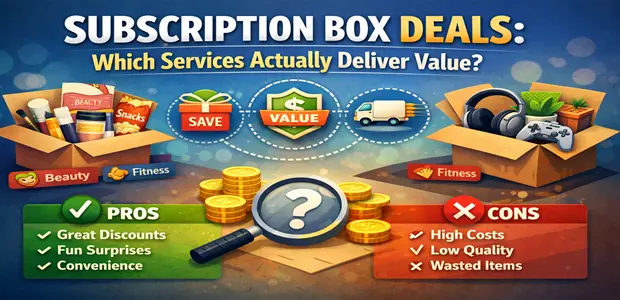
Subscription box deals have become one of the most aggressively marketed product categories in retail — and one of the most financially misunderstood. The core promise is compelling: curated products, delivered to your door, at a discount versus buying individually. But the actual value delivered varies enormously by category, and the business models behind these services are specifically designed to keep you subscribed long past the point where you’re genuinely benefiting.
This guide audits the subscription box landscape honestly. We’ll identify which categories deliver genuine value, which are structured liquidity traps, and how to approach any subscription offer so you capture the upside without getting locked into a costly inertia cycle.
📩 Join the DEALSisHERE Insider Network — Stop letting “free trial” mechanics quietly drain your budget. Get institutional-grade subscription analysis, cancellation strategy guides, and real-time deal alerts delivered directly to your inbox. Subscribe Now →
Quick Recommendations
Not all subscription box categories are created equal. Here’s the verdict by niche before we go deeper:
- Best value category: Grooming & shaving (consistent consumables, genuine margin compression)
- Conditional value: Meal kits (only during introductory discount windows; cancel before full price)
- Avoid long-term: Beauty & cosmetics (sample sizes, low utilization rates, growing inventory clutter)
- Avoid entirely: Tech & gadget boxes (liquidation vehicles for unsellable inventory)
- Best specific service (meal kits): HelloFresh
- Best specific service (grooming): Dollar Shave Club / Harry’s
- Best specific service (books): Book of the Month
- Best specific service (snacks): Universal Yums / Graze
How Subscription Box Economics Actually Work
Before the category breakdowns, it’s worth understanding the business model you’re subscribing to.
Subscription box companies don’t primarily make money selling you products. They make money on continuity — the statistical reality that a significant percentage of subscribers forget to cancel, find the cancellation process frustrating enough to give up, or keep the subscription running out of inertia long after it stopped being useful.
The introductory offer — “$5 for your first box,” “First month free,” “60% off your first three deliveries” — is a customer acquisition cost, not generosity. The company has calculated that acquiring you at a loss in month one is profitable if you stay for six months or more at full price.
Understanding this dynamic doesn’t mean all subscriptions are bad. It means you need to evaluate them differently from a one-time purchase.
For a deeper breakdown of the psychological mechanics behind these introductory offers and how they exploit the same cognitive triggers as online flash sales, see: The Psychology of Flash Sales: How to Make Smart Buying Decisions →
Comparison Matrix
| Service | Best For | Key Strength | Potential Drawback | Verdict |
|---|---|---|---|---|
| HelloFresh | Households cooking 3–5 nights/week | Reduces meal planning friction and food waste | 30–40% more expensive than equivalent raw groceries | Strong value during intro period; reassess at full price |
| Dollar Shave Club | Anyone who buys razors regularly | Eliminates retail markup on consumables you’ll always need | Limited product range beyond razors | Genuine long-term value for consistent users |
| Harry’s | Precision grooming buyers | Higher-end blade quality, still below retail equivalent | Slightly pricier than DSC | Good alternative for quality-focused users |
| Birchbox / Ipsy | Beauty product explorers | Low cost discovery of new brands | Mostly samples; low utilization rate | Low ROI for most subscribers |
| Book of the Month | Consistent readers | Hardcover books at below-retail pricing | Only works if you read consistently | Strong value for the right user profile |
| Universal Yums | Snack explorers / gift buyers | Genuine novelty and discovery value | Not a staple — consumable entertainment | Good as occasional gift, weak as budget-line item |
| Loot Crate / Geek Fuel | Pop culture fans | Themed collectibles and licensed merchandise | Almost entirely unsellable inventory liquidation | Avoid for value-seekers |
Individual Service Reviews
HelloFresh (Meal Kit)
Overview
HelloFresh is the dominant meal kit service globally, operating in 18 countries and serving millions of weekly subscribers. It delivers pre-portioned ingredients and recipe cards for 2–5 meals per week, targeting households who want to cook at home but struggle with the planning and shopping overhead.
Introductory discounts are consistently aggressive — first-box discounts of 40–60% are standard, with multi-box promotional sequences common.
Pros
- Eliminates weekly meal planning and grocery list friction
- Pre-portioned ingredients dramatically reduce food waste versus open-packet grocery shopping
- Recipe variety is genuinely broad and quality has improved significantly
- Introductory pricing represents real value — the discount is meaningful
- Flexible — easy to skip weeks without cancellation
Cons
- Full-price per-serving cost (typically $9–$13 per serving) is 30–40% above equivalent raw grocery cost
- Packaging waste is substantial — significant single-use plastic per delivery
- Quality of fresh produce can be inconsistent depending on delivery conditions
- Cancellation process is multi-step and deliberately friction-heavy
Best For
Households that currently rely heavily on takeout or delivery apps and want to shift toward home cooking. In that context, HelloFresh is genuinely cheaper than the alternative. It’s a poor value for households that already cook efficiently.
Why We Recommend It (With Conditions)
Use the introductory offer. Skip weeks aggressively when needed. Reassess at the 3-month mark when full pricing kicks in. If you’ve built a home-cooking habit and no longer need the recipe scaffolding, cancel and shop independently. The service has legitimate utility — just not at full price for most households.
Dollar Shave Club / Harry’s (Grooming)
Overview
Grooming subscription services — Dollar Shave Club (DSC), Harry’s, Billie, and similar — occupy the most financially defensible subscription box category available. Razors, blades, and shaving products are true consumables with predictable replacement cycles and significant retail markup at pharmacy and supermarket prices.
DSC and Harry’s both undercut retail razor prices by 20–40% on a per-blade basis while delivering comparable or better blade quality than mass-market brands.
Pros
- Genuine unit-cost savings versus retail equivalents (Gillette, Schick)
- Consumable products you will buy regardless — the subscription replaces a retail purchase, not an optional one
- Flexible delivery cadence matches actual consumption rate
- Product quality has been independently validated to match or exceed mass-market blades
Cons
- Product range beyond razors is hit-or-miss; stick to the core razor subscription
- Some users find they receive blades faster than they consume them — adjust delivery frequency
- Not a meaningful category for people who don’t shave regularly
Best For
Anyone who currently buys razors at full retail price. The math is straightforward: if you’re spending $15–$20/month on retail razors and blades, a subscription at $8–$12/month for equivalent quality is an immediate, permanent saving.
Why We Recommend It
This is the category where subscription boxes actually deliver on their promise without caveats. You’re replacing a recurring retail expenditure with a lower-cost alternative. There’s no inertia risk because the product is useful by definition — if you’re subscribed, you’re using it.
Book of the Month (Books)
Overview
Book of the Month (BOTM) sends subscribers one hardcover book per month, selected from a curated list of five new releases. Additional books can be added at a discount. At roughly $16–$17/month for a new hardcover (retail $26–$32), the value proposition is genuine for readers who finish at least one book per month.
Pros
- Below-retail pricing on new hardcover releases
- Curated selection reduces decision fatigue for readers
- Books are physical assets with lasting value — not consumables that disappear
- Skip months are available with no penalty
Cons
- Value only works if you read consistently — one unread book per month is a $16 waste
- Selection is limited to five titles; you may not want any of them in a given month
- Digital readers (Kindle) get no benefit — the product is physical books only
Best For
Consistent readers who finish one or more books per month and prefer physical hardcovers. For this profile, it’s one of the best-value subscriptions available.
Why We Recommend It
The unit economics are clear and honest. A new hardcover at $16 versus $28–$32 retail is a genuine saving on a product you wanted anyway. Skip months liberally when the monthly selection doesn’t appeal.
Birchbox / Ipsy (Beauty & Cosmetics)
Overview
Beauty subscription boxes typically deliver 4–6 sample-sized or travel-sized products monthly for $12–$15. The pitch is discovery — try products before committing to full sizes.
In practice, the utilization rate for beauty samples is among the lowest of any subscription category. Most subscribers use 1–2 items per box and accumulate a growing collection of unused travel-size products.
Pros
- Low monthly cost ($12–$15)
- Genuine brand discovery for beauty enthusiasts
- Occasional inclusion of full-size products
Cons
- Majority of products are travel/sample size — not replacing any actual purchase
- Utilization rates are statistically low; unused product accumulation is common
- “Value” claims based on MSRP of sample items are frequently inflated
- Category has significant churn — the novelty wears off faster than other categories
Best For
Beauty enthusiasts who specifically want discovery at low cost and have realistic expectations about sample sizes. Not suitable as a “savings” mechanism.
Why We Recommend It (With Strong Caveats)
At $12–$15/month, the loss is contained if the service underdelivers. Treat it as entertainment rather than savings — a small monthly budget for trying new products. If you find yourself not using what arrives, cancel promptly.
Universal Yums (International Snacks)
Overview
Universal Yums delivers snacks from a different country each month, positioned as a culinary discovery experience. The product is genuinely what it claims to be — unusual, region-specific snacks not available in standard retail channels.
Pros
- Genuine novelty and discovery value
- Excellent gift option — solves the “what to get someone who has everything” problem
- Interesting as a shared household experience
- Products are genuinely unavailable through standard retail channels
Cons
- Snacks are consumable entertainment, not staple nutrition
- Per-snack cost is high relative to equivalent domestic snack spending
- No long-term utility — it’s a novelty subscription
Best For
As a gift subscription. As a household entertainment budget item for food-curious subscribers. Not as a budget-optimization tool.
Why We Recommend It
It’s honest about what it is — a novelty experience, not a savings mechanism. If you’re buying it knowing that, it delivers on its promise. Don’t subscribe expecting to save money on snacks.
Tech & Gadget Boxes (Category Review)
Overview
Tech gadget subscriptions — Loot Crate, various “mystery box” electronics services — promise surprising tech accessories and gadgets at below-retail value.
In practice, these boxes function primarily as inventory liquidation vehicles. The products included are generally items that failed to sell through normal retail channels: off-brand accessories, obsolete gadgets, licensed merchandise without a market. The “retail value” claims are fabricated against inflated MSRP figures for products no one was buying at those prices.
Pros
- Occasionally includes a genuinely useful item
- Low-cost entry point creates a sense of discovery
Cons
- Products are largely low-quality or redundant
- “Value” calculations are based on inflated MSRP of unsellable inventory
- Accumulates low-utility clutter rapidly
- No reliable way to know what you’re receiving or whether you’ll use it
Best For
Nobody seeking genuine value. Possibly appropriate as a novelty gift for gadget-curious teenagers with zero expectations.
Why We Do Not Recommend It
This is the category where the subscription box model is at its most exploitative. You’re paying to receive someone else’s excess inventory at a price you’ve been convinced is a discount. Verify claimed product values using price tracking tools — you’ll find most are fictional.
To verify any subscription box’s claimed product values against real market prices, see: Price Tracking Apps Showdown: 7 Tools That Actually Save You Money →
Buying Guide: How to Evaluate Any Subscription Box
The Three-Phase ROI Audit
Before subscribing to anything, run this sequence:
Phase 1 — Utilization Rate Check. Estimate honestly what percentage of the box you’ll actually use. If a five-product beauty box results in you using two products, your effective utilization is 40%. Divide the box cost by the number of products you’ll use to find your real per-item cost.
Phase 2 — MSRP Verification. Don’t trust the “total retail value: $120” claim on the box. Look up each item individually using a price tracking tool (Keepa for Amazon-listed items, Google Shopping for others). The real market price is almost always lower than the claimed MSRP.
Phase 3 — Convenience Premium Calculation. For services like meal kits, calculate the time you save versus the price premium you pay. If HelloFresh saves you 3 hours of weekly meal planning and shopping, and you value your time at $20/hour, the $25–$40 weekly premium may be justified. If you already shop efficiently, it isn’t.
The Introductory Offer Strategy
The most financially disciplined approach to subscription boxes is straightforward:
- Sign up for the introductory offer.
- Set a calendar reminder for the billing date when full pricing begins.
- Evaluate honestly at that point — does the service still deliver value at full price?
- Cancel if not, or skip weeks aggressively to reduce cost.
- Move to a competitor’s introductory offer when available.
This approach — sometimes called “churn and burn” — is legitimate and financially rational. Subscription companies budget for it in their customer acquisition costs. You’re using the system as it’s actually structured, not gaming anything.
Common Mistakes Buyers Make
Trusting “retail value” claims without verification. The $80 moisturizer in the beauty box may retail for $12 on Amazon. Verify everything independently.
Not setting a cancellation reminder. The most expensive subscription is the one you forgot to cancel. Set the reminder the moment you sign up, not when you remember to think about it.
Subscribing to multiple boxes simultaneously. Overlapping subscriptions in the same category amplify the clutter problem without proportionally increasing utility.
Treating sample-size products as equivalent to full-size. A 5ml moisturizer sample is not a $35 full-size product. It’s a trial. Evaluate accordingly.
Budget Considerations
The total cost of a subscription is always higher than the monthly headline price:
- Annual spend = monthly fee × 12
- Add shipping if not included
- Add the cost of any “add-on” items you consistently purchase
A $15/month beauty box costs $180/year. A $65/month meal kit costs $780/year. Run the annual number before subscribing — it changes the decision calculus significantly.
Long-Term Value Assessment
Only two subscription categories consistently deliver genuine long-term value:
Grooming/consumables — because you’re replacing a retail purchase with a cheaper equivalent. The subscription is financially superior to the alternative by definition.
Books (for consistent readers) — because the unit economics are transparent and the product has lasting value.
All other categories require ongoing honest reassessment. The question is not “am I getting a good deal on what’s in the box?” but “would I choose to spend this money this way if I were allocating my budget from scratch today?”
Frequently Asked Questions
Q: Are subscription boxes ever actually worth the full price?
Yes — in consumable categories where you replace an existing retail purchase with a cheaper subscription equivalent. Grooming (DSC, Harry’s) and consistent reading (Book of the Month) are the clearest examples. Categories built on “discovery” or “surprise” tend to deliver diminishing returns after the novelty period ends.
Q: How do I calculate whether a meal kit is saving me money?
Compare your current average weekly food spend (groceries + takeout + delivery) against the meal kit’s full-price weekly cost. If the meal kit is cheaper and you’re eating better, it’s financially positive. If you’re still supplementing with groceries and takeout on top of the kit cost, you’re spending more, not less.
Q: What’s the safest way to try a subscription box?
Sign up for the introductory offer, set a calendar reminder for three days before the first full-price billing date, and evaluate then. If you want to continue, cancel the reminder. If not, cancel the subscription. Never allow more than one full-price cycle to bill before you’ve made a conscious decision to continue.
Q: Are the “retail value” claims on subscription boxes accurate?
Rarely. MSRP figures used in subscription box marketing are frequently inflated — especially for beauty and tech categories. The genuine market price of included products is typically 40–60% of the claimed retail value. Use price tracking tools to verify independently before concluding a box is good value.
Q: Is it bad practice to subscribe, take the discount, and cancel?
No. Subscription companies price their introductory offers knowing that a percentage of subscribers will cancel after the promo period. It’s budgeted into their customer acquisition model. You’re operating within the system as designed. The ethical obligation is simply to use the cancel function promptly rather than disputing charges after the fact.
Final Verdict
Subscription boxes deliver genuine value in a narrow set of circumstances: consumable products you purchase anyway (grooming, coffee, specific pantry staples), and curated physical goods with transparent pricing (books). Outside these categories, the value proposition degrades quickly — and the business model is specifically structured to keep you paying past the point of genuine benefit.
The framework is simple. Identify whether the subscription replaces an existing expenditure (good) or creates a new one (scrutinize carefully). Verify “retail value” claims independently. Use introductory offers deliberately, set cancellation reminders immediately, and reassess at full price without inertia.
The best subscription is one you’d actively choose to continue at full price if you had to sign up again today. Apply that test monthly.
🚀 High-Velocity Capital Preservation & Sourcing Alerts
Stop letting “free trial” traps and forced continuity mechanics quietly extract capital from your monthly budget:
📩 Subscribe to the DEALSisHERE Newsletter → — Institutional-grade subscription analysis, cancellation strategy guides, and strategic procurement intelligence for asset-focused digital professionals.
Affiliate Disclaimer: We may earn a commission if you make a purchase through our links, at no extra cost to you. This never influences our editorial verdicts — all services are evaluated independently based on genuine value delivery and honest unit economics.
Advertisement
Advertisement