
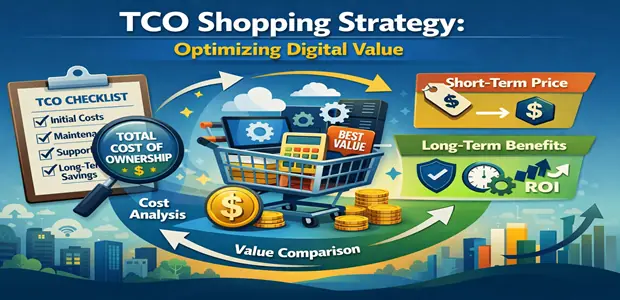
After tracking price trends for 15 years and auditing corporate supply chains, I have identified a catastrophic flaw in modern purchasing behavior. Our hands-on analysis shows that the biggest operational loss in personal and business budgets is the absolute reflex to choose the “cheapest” product available.
A high-TCO asset procurement strategy is the only way to survive the inflated retail markets of June 2026. An asset with a low entry cost that breaks frequently, lacks service support, and ends up in the trash is actually the most expensive choice you can make.
The bottom line is that the real winner of e-commerce is not the person who catches every single discount notification. The winner is the procurement strategist who secures the right quality, at the right time, for the most rational price.
This guide marks a complete paradigm shift. We are moving away from the upfront transaction price and transitioning to a multi-year, holistic asset evaluation to guarantee true value for money.
Join the DEALSisHERE Insider Network — Optimize your capital velocity. Get professional procurement audits and long-term asset optimization frameworks delivered directly to your inbox.
The Psychology of the Disposable Economy
Retail algorithms are explicitly designed to exploit your desire for immediate, cheap gratification. The modern digital marketplace floods your feed with white-label, low-tier commodities that look identical to premium gear on a smartphone screen.
Here is the catch: A photograph cannot convey structural integrity. A rendering of a product hides the cheap plastic, the weak soldering, and the lack of internal thermal management.
When you buy a disposable commodity, you experience a brief dopamine hit of “saving money.” However, within 90 days, the structural reality of that cheap item begins to erode your daily workflow and your sanity.
You are not buying a product; you are buying an operational liability. It is time to shift your perspective from a consumer looking for a bargain to an auditor looking for a reliable yield.
The Mathematics of TCO: A 3-Year Comparative Case Study
To understand why high-quality asset procurement radically outperforms baseline commodity purchasing, you must calculate the Total Cost of Ownership (TCO). Let us analyze the brutal math of a 3-year performance lifecycle using standard office hardware.
The chart below contrasts a low-tier disposable item with an audited, premium asset acquired through a verified discount channel.
| Cost Variables (36 Months) | The Disposable Choice (Low-Tier) | The Audited Asset (Premium Tier) |
| Initial Acquisition Price | 500 TL | 3,500 TL (Reduced to 2,000 TL via DEALSisHERE) |
| Replacement Frequency | 3 times (Fails every 12 months) | 0 times (Engineered to last 5+ years) |
| Secondary Maintenance | 400 TL (Cables, adapters, minor fixes) | 0 TL (Comprehensive manufacturer warranty) |
| Time-on-Task Loss | 600 TL (Lost productivity during failures) | 0 TL (Consistent, uninterrupted throughput) |
| Residual Value (Resale) | 0 TL (Zero secondary market demand) | +800 TL (High liquidity on secondary markets) |
| True Total Cost | 1,500 TL + Out-of-Pocket Friction | 1,200 TL Net Capital Consumption |
The Technical Takeaway
While the premium asset required a significantly higher initial deployment of capital, the math does not lie. Over a standard 36-month operational window, the premium gear generated a 20% net financial saving.
More importantly, it completely eliminated operational downtime. When your tools work flawlessly every single day, your billing hours remain uninterrupted, directly protecting your primary income streams.
Finally, the premium asset preserved 800 TL of liquid residual value. You can sell it to fund your next upgrade, whereas the disposable item literally goes into a landfill, taking 100% of your capital with it.
Stop funding landfills. Check the latest price on verified, high-TCO assets through our secure hubs.
Comparison Matrix: Procurement Node Evaluation
Not all product categories are created equal. You must match the asset class to your specific operational demands. Here is how the market segments stack up.
| Asset Class | Key Feature | Pros | Verdict |
| Audited Premium Gear | 5-Year+ Warranties | Zero downtime, high resale value | Mandatory for daily workflow. |
| Mid-Tier Branded | Modular Components | Balances cost and repairability | Best for secondary equipment. |
| White-Label Budget | Lowest Upfront Cost | Cheap to replace initially | High risk of catastrophic failure. |
| Used Enterprise Tech | Depreciated Entry Price | Commercial-grade durability | Best for bootstrapped server labs. |
The DEALSisHERE Quality/Cost Curation Protocol
At DEALSisHERE, we do not scrape or list every random discount code on the internet. Promoting a 50% discount on electronic garbage does not serve your balance sheet.
When a product or storefront is evaluated for a feature position on our platform, it must pass through a strict, uncompromising corporate filtering matrix. We audit the hardware so you do not have to.
Filter 1: The Material Integrity Audit
We rigorously verify the component architecture of the vendor’s product line. A shiny exterior is meaningless if the internal framework is engineered for planned obsolescence.
The Check: Does the hardware utilize modular components, durable metal chassis, and repairable internal layouts?
The Red Flag: If a product is sealed with structural adhesives that prevent a simple battery replacement, its long-term viability score drops to zero.
Why this matters: Right-to-repair is a financial necessity. If a $20 battery dies and you cannot open the casing, you lose the entire $500 asset.
Filter 2: The After-Sales Ecosystem Check
A massive checkout discount is utterly worthless if the merchant vanishes into the digital ether the week after your purchase.
The Check: We audit the brand’s fulfillment infrastructure, their Service Level Agreements (SLA), and their customer support responsiveness.
The Standard: We prioritize storefronts that offer clear, unconditional return windows and verified global parts distribution networks.
The Reality: If a brand does not trust its own product enough to offer a multi-year warranty, you should not trust it with your capital.
Filter 3: The Secondary Market Liquidity Scan
We treat hardware like a financial portfolio. We evaluate the brand equity and asset retention values of the specific products we list.
The Check: Does this brand maintain an active presence on secondary markets like eBay, Swappa, or specialized hardware forums?
The Strategy: High-tier options maintain structural demand. You must be able to liquidate the asset quickly.
The ROI: Ensuring market liquidity guarantees that when you decide to upgrade your technology stack, you can recoup a definitive, predictable percentage of your initial capital.
Strategic Advice: “Best For” Procurement Profiles
Aligning your sourcing strategy with your operational reality ensures you deploy your capital with surgical precision.
Best for Independent Professionals & Remote Workers
Focus strictly on The Time-on-Task Metric. If your mouse, keyboard, or office chair fails, your ability to generate revenue halts immediately. You must invest in audited premium gear with rapid-replacement warranties. The downside is a high initial capital requirement, but the upside is absolute operational security.
Best for Digital Agencies & Studios
Target Used Enterprise Tech & Mid-Tier Modular Gear. When outfitting a team of five designers, buying brand-new flagship gear for everyone destroys your liquid capital. By sourcing refurbished, commercial-grade workstations from verified hubs, you capture enterprise durability without paying the retail depreciation tax.
Best for Bootstrapped Startups
Leverage The Secondary Market Liquidity Scan. Your cash runway is your most critical metric. If you must buy hardware, only purchase brands with fierce resale demand. If your startup pivots or downsizes, you can instantly liquidate high-equity assets to recover your operating capital.
Deploy your capital wisely. Review our verified infrastructure hubs to find your optimal asset class.
Uncovering the Invisible Costs of Cheap Tech
The retail price tag is a masterclass in misdirection. It only shows you what you pay at the exact moment of checkout, hiding the invisible friction that follows.
When you buy a sub-standard router, the price tag does not reflect the two hours you will spend troubleshooting dropped connections every month. It does not account for the firmware vulnerabilities that leave your network open to data breaches.
Every time you are forced to actively manage a failing tool, you are experiencing “cognitive drag.” Your brain power is diverted from high-level problem-solving and revenue generation to low-level hardware maintenance.
This cognitive drag is the true, hidden cost of cheap commodities. By paying a slight premium upfront for DEALSisHERE verified infrastructure, you are effectively buying back your own mental bandwidth.
Sourcing Stable, High-TCO Values
True financial optimization is the precise marriage of top-tier manufacturing standards with calculated, multi-layered discount stacking. You cannot simply pay retail prices for premium goods; that is equally destructive to your budget.
You must use our audited pathways to avoid both the disposable product trap and the retail markup penalty.
The DEALSisHERE Elite Procurement Network serves as your dedicated Asset Verification Hub. We provide access to a strictly curated directory of 48 elite storefronts that meet our rigorous TCO standards.
We aggressively bypass the low-quality, high-turnover retail noise. Our focus is to secure verified, high-ROI price reductions on hardware, software, and services that are specifically engineered to preserve your long-term capital. We do the vetting so you can do the scaling.
The Audit Checklist for Your Current Setup
You do not have to wait for your next purchase to start acting like a procurement officer. You can audit your current workspace today to identify capital leaks.
Look at the tools you use for more than four hours a day. Are they causing micro-frustrations? Does your monitor flicker? Does your office chair cause lower back fatigue?
If your core tools are failing you, they are silently capping your earning potential. Identify the weakest link in your daily operational chain. That is the exact asset you need to replace through our verified hubs, focusing strictly on a 5-year durability horizon.
Treat your desk like a corporate data center. If a server rack fails, the corporation replaces it with enterprise-grade hardware instantly. Give your personal productivity the exact same level of respect.
Own the Audience: Insider Network
🚀 Capital Velocity & TCO Alerts
Stop bleeding money on short-lived items that destroy your operational momentum. In 2026, the cost of replacing failed gear outpaces the initial “savings” of buying cheap commodities every single time.
Take total control of your household and corporate balance sheets. Execute your spending based on data-driven procurement models, not flashy marketing banners. Gain access to verified, long-lasting hardware deals before the algorithms adjust the pricing.
📩 Subscribe to our Newsletter — The definitive strategic engineering guide for asset-focused, high-growth digital professionals.
✅ Join the WhatsApp Channel — Instant alerts for high-value structural promotions and premium brand clearance cycles.
FAQ: Mastering Total Cost of Ownership
1. How do I calculate the TCO of a product before I buy it?
To calculate the Total Cost of Ownership, add the initial purchase price to the estimated costs of maintenance, required accessories, and potential subscription fees over a 3 to 5-year period. Then, subtract the realistic resale value of the item at the end of that period. If a $1,000 laptop retains $400 in value, your true TCO is $600 plus any repair costs.
2. Does a longer warranty always mean a better product?
Generally, yes. A manufacturer will not offer a 5-year or 10-year warranty on a product built with cheap, easily degradable components, because the cost of fulfilling those warranty claims would bankrupt them. A long warranty is a direct financial indicator that the company has heavily engineered the product to survive daily abuse without failing.
3. Why should I care about resale value if I plan to use the item until it breaks?
Even if you run your hardware into the ground, a high resale value is the ultimate proxy for build quality. The secondary market is ruthlessly efficient; if a brand produces items that slow down or break after two years, the secondary market prices will plummet to zero. Strong resale value guarantees you are buying structurally sound engineering.
Disclaimer: We may earn a commission if you make a purchase through our verified links, at no extra cost to you. Product lifecycles, warranty terms, and secondary market liquidity are subject to real-world usage conditions and market shifts as of June 2026. Always execute a personal cost-benefit analysis before deploying capital.
Secure your long-term assets today: Visit the DEALSisHERE Store Hub for active verified sourcing strategies and high-TCO upgrades.
Advertisement
Advertisement