
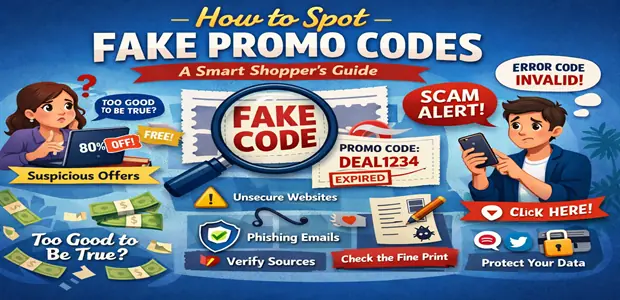
By the DEALSisHERE Senior Shopping & Consumer Technology Team | Last Updated: June 10, 2026
Fake promo codes are not just a minor inconvenience — they’re a structured digital security threat that operates specifically when your cognitive defenses are lowest. The moment you’re at a checkout screen searching for a discount code, your purchase intent is high and your skepticism is low. Fraudsters know this. The fake promo code ecosystem is built entirely around exploiting that window.
Understanding how to spot fake promo codes is one of the most practical digital security skills a modern shopper can develop — and it directly protects both your money and your personal data from the networks built to harvest them.
📩 Join the DEALSisHERE Insider Network — Stop exposing your personal data to fraudulent coupon networks. Get fully audited, institutional-grade promo codes and digital security alerts delivered directly to your inbox. Subscribe Now →
Quick Recommendations
- Most reliable code source: Retailer’s own website (official promotions page or checkout coupon field)
- Best third-party verified database: DEALSisHERE audited coupon directory
- Best automated code tool: Honey or Capital One Shopping (tests codes without requiring you to source them)
- Best browser security practice: Clear cookies before any coupon site visit; use HTTPS-only mode
- Red flag to memorize: Any site requiring email, survey, app download, or payment to “reveal” a code is a data harvest operation
- Social media rule: Never click promo links in comment sections — only from official brand bios or verified directories
Comparison Matrix: Safe vs. Risky Promo Code Sources
| Source | Best For | Key Strength | Potential Drawback | Verdict |
|---|---|---|---|---|
| Retailer’s own site (official promo page) | First-party verified codes | Zero fraud risk — direct from merchant | Limited to what the retailer publicly promotes | Always check here first |
| DEALSisHERE audited directory | Curated, tested multi-retailer codes | Verified against live POS systems; no data walls | Requires checking before checkout | High-trust third-party source |
| Honey / Capital One Shopping | Automated code injection at checkout | Tests hundreds of codes without manual sourcing | Privacy considerations (data collection) | Strong convenience option |
| Reddit (r/frugal, r/deals) | Community-sourced real-time codes | Real users reporting live codes with outcomes | Requires thread date verification | Useful with time-stamp caution |
| Random Google search result coupon sites | Avoid | N/A | High scam/phishing risk, outdated codes, data walls | Do not use |
| Social media comment section links | Avoid | N/A | Near-universally phishing or malicious affiliate cookies | Never click |
The Anatomy of Fake Promo Code Operations
Before the verification tools, it helps to understand what fake promo code sites actually are and how they make money from you even when they don’t steal your data outright.
The data harvest model: The most common operation requires you to “unlock” the code by entering your email address. Your email is then sold to spam lists or used for phishing campaigns. The code that appears after submission is either expired, fake, or a generic code that doesn’t work.
The malicious affiliate cookie model: More sophisticated operations don’t need your data at all. When you click a link on a fraudulent coupon page, a malicious affiliate cookie is dropped in your browser. This cookie silently attributes any purchase you make at a major retailer within the next 24–72 hours to the scammer’s affiliate account — stealing the commission from the retailer without providing you any discount. You pay full price; they get paid.
The survey trap: Sites that require completing a survey before revealing a code are running lead generation operations. Your survey responses are profiled and sold. The code at the end rarely works.
The fake extension model: Some sites prompt you to download a browser extension “to automatically apply the best codes.” These extensions frequently monitor your complete browsing activity, inject ads, or modify checkout pages in ways that redirect affiliate commissions.
Individual Tool Reviews: Verified Promo Code Sources
DEALSisHERE Verified Coupon Database
Overview
A curated, continuously tested database of active promo codes across major retailers, where every alphanumeric string is verified against the retailer’s live point-of-sale system before publication. Codes that fail are removed; expired codes are purged automatically.
The database covers Amazon, AliExpress, major apparel retailers, software subscriptions, VPN services, and smart home product brands — the categories where code fraud is most prevalent.
Pros
- Codes verified against actual checkout systems — not scraped from expired forums
- No data wall — codes displayed in plain text without email requirements, surveys, or downloads
- HTTPS-encrypted, no malicious cookie injection
- Covers manufacturer-funded codes that automated tools frequently miss
- Regularly updated across active promotional cycles
Cons
- Coverage focused on high-volume retailers — niche or local retailers may not be included
- Real-time verification can mean occasional brief gaps between a code expiring and removal
Best For
Any shopper who wants verified codes without the security risk of random coupon sites, particularly for Amazon, AliExpress, and subscription-category retailers.
Why We Recommend It
The zero-data-wall policy is the defining differentiator. A legitimate promo code doesn’t need your personal information to reach you. If a site requires anything before showing you a code, that’s the signal to close the tab.
Honey (PayPal Rewards)
Overview
Honey is a browser extension that automatically tests available promo codes when you reach a retailer’s checkout page. It operates in the background and surfaces the highest-yielding valid code without requiring you to manually search for one.
The security advantage: Honey’s code testing operates within the retailer’s legitimate checkout system. No external redirects, no data walls, no malicious cookies introduced in the code sourcing process. The code either applies or it doesn’t — immediately visible in the order summary.
Pros
- Automated code testing removes the need for manual search entirely
- Code validity is confirmed in real time at checkout
- No requirement to navigate to third-party coupon sites
- Works across thousands of retailers globally
- Doubles as a price tracking tool (Droplist feature)
Cons
- PayPal acquisition has raised data privacy concerns — review the current privacy policy
- Not every retailer has codes in Honey’s database; frequent “no codes found” results in niche categories
- Honey Gold cashback rewards convert to PayPal credits, not direct cash
- Cannot surface manufacturer-funded codes that aren’t in its database
Best For
Shoppers who want to eliminate the manual code search step entirely and are comfortable with the data collection trade-off of a browser extension.
Why We Recommend It
Honey’s primary security value is that it removes the most dangerous moment in coupon hunting — the Google search for “retailer promo code” that surfaces fraudulent results. If the code exists and is in Honey’s database, it applies automatically. You never need to navigate to a third-party site.
Capital One Shopping
Overview
Capital One Shopping operates on the same automated code-injection model as Honey but with additional cross-retailer price comparison functionality. It scans competing retailers simultaneously when you’re on a product page, surfacing lower prices alongside available coupon codes.
Pros
- Automated code injection without manual searching
- Real-time cross-retailer price comparison adds comparison value beyond code injection
- No requirement to navigate to third-party coupon pages
- Browser extension is lightweight
Cons
- Comparison results can be skewed toward Capital One-affiliated retailers
- Some users report slower checkout page performance with the extension active
- Potential conflict with Honey if both are installed simultaneously
Best For
Shoppers who want both code injection and price comparison in a single tool and don’t use Honey.
Why We Recommend It
The cross-retailer comparison distinguishes it from Honey in use cases where you’re not certain the retailer you’re on has the best price. Installing both Honey and Capital One Shopping simultaneously creates checkout script conflicts — choose one.
Reddit Deal Communities
Overview
Subreddits including r/frugal, r/deals, and retailer-specific communities (r/AmazonDeals) function as crowdsourced real-time code repositories. Users post working codes with confirmation from other commenters who’ve applied them successfully.
Pros
- Real-time, community-verified codes with user-confirmed success reports
- Covers time-limited promotions that automated tools haven’t indexed yet
- Photo/video proof of applied discounts provides validation
- Zero data collection — Reddit threads require no personal information
Cons
- Post date verification is essential — a thread from 2024 is not a current code
- Community enthusiasm can occasionally misidentify expired codes as active
- Requires active search rather than automated surfacing
- Thread quality varies; verify success confirmation in comments before applying
Best For
Shoppers looking for codes on niche retailers, short-term flash promotions, or categories not covered by automated tools.
Why We Recommend It (With Caveats)
Reddit deal communities are the most transparent code source available — real users, real outcomes, identifiable post dates. The critical step is checking the thread date before applying any code. A confirmed working code from last Tuesday is reliable; the same code from last October is not.
Buying Guide: Building a Safe Code-Finding Workflow
The Three-Phase Verification Protocol
Before entering any promo code at checkout, run this sequence:
Phase 1 — URL integrity check. If you’ve navigated to a coupon site from a search result, examine the URL before entering any information. Legitimate retailers and verified directories operate on clean HTTPS domains. Suspicious indicators: misspelled brand names, extra hyphens, unusual top-level domains (.xyz, .top, .click), or URLs that include the brand name in a subdomain (amaz0n.deals.net is not Amazon).
Phase 2 — Data wall check. Before proceeding past the landing page of any coupon site: is the code visible in plain text, or is it behind an email field, survey, or app download prompt? Legitimate promo codes are displayed openly. Any friction between you and the code text is a data extraction mechanism.
Phase 3 — Link behavior check. Before clicking any “Activate Deal” or “Get Code” button, hover over the link and check where it actually points (visible in your browser’s status bar). Legitimate links redirect cleanly to the retailer’s domain. Links that trigger multiple redirects, open new tabs to unrelated sites, or download files are not legitimate coupon links.
Recognizing Fake Code Structure
Real promo codes have recognizable structural characteristics:
Legitimate code indicators:
- Specific discount with minimum purchase threshold (e.g., “15% off orders $50+”)
- Defined expiration date or “while supplies last” language
- Category or product exclusions clearly stated
- Code is 6–15 characters, alphanumeric, typically uppercase
Fake code red flags:
- “90% off entire store, no exclusions, no expiration” — structurally impossible for a retailer to offer
- “Only 2 uses remaining” combined with a refreshing countdown timer
- Unlimited percentage claims without any qualifying terms
- Code requires verification via email, phone number, or social share before display
The Social Media Scam — Specific Warning
One of the most prevalent current fraud vectors: fraudsters reply to official brand posts on Facebook, Instagram, and X with comments reading “Get 50% off here! [link]” These links are nearly universally phishing pages, malicious affiliate cookies, or malware downloads.
The rule: Never click a promo link in a comment section. Official brand promotions appear in the brand’s own posts, bio links, or email communications — never in reply comments from third-party accounts.
If you see a promotional comment on an official brand’s social media post, report it directly to the platform. These are spam accounts running automated operations.
Common Mistakes Shoppers Make
1. Googling “retailer + promo code” at checkout. The search results for generic code queries are dominated by SEO-optimized coupon aggregators with outdated codes and data collection walls. Use verified directories or automated tools instead.
2. Using the same browser session for coupon site browsing and checkout. Malicious affiliate cookies dropped on fraudulent coupon pages persist through your session. If you’ve visited a suspicious site, clear cookies before completing any purchase.
3. Downloading coupon browser extensions from unknown sources. Only install extensions from developers with established reputations (Honey/PayPal, Capital One) or that appear in your browser’s official extension store with verified publisher information and significant install counts.
4. Assuming a code “works” because it doesn’t produce an error. Some fraudulent codes apply a $0 discount without producing an error message — the “invalid code” alert never appears, but the price doesn’t change. Always verify the subtotal recalculated before clicking “Place Order.”
5. Trusting social proof from anonymous accounts. Comments saying “This code worked for me!” on a coupon site are frequently automated or paid. Verify with Reddit community confirmation or first-party retailer channels instead.
Long-Term Value of Safe Code Practices
The value of building a verified code workflow compounds over time. A household that captures an average 15% discount through verified stacked codes across $10,000 in annual spending saves $1,500 per year — with zero exposure to the data collection, cookie injection, and phishing risks that accompany random coupon site usage.
The security benefit extends beyond money: protecting your email from spam lists, your browser from malicious extensions, and your affiliate relationships from cookie-hijacking operations maintains the integrity of your digital security profile.
Frequently Asked Questions
Q: How do I know if a coupon site is legitimate?
Check four things: (1) the code is displayed in plain text without requiring any personal information; (2) the site operates on a clean HTTPS domain without typos or unusual structure; (3) clicking the code redirects cleanly to the retailer’s domain without intermediate pages; (4) the discount claims are specific and bounded (percentage, minimum purchase, expiration) rather than sweeping “90% off everything” claims.
Q: Can malicious coupon sites actually steal my payment information?
Not directly from a coupon site visit in most cases — payment information is only at risk when you enter it on a fake checkout page (a different threat). The primary risks from fraudulent coupon sites are: data collection (email, behavioral), malicious affiliate cookie injection, malware from extension downloads, and phishing page redirects. Keep payment information for the retailer’s own checkout exclusively.
Q: What’s the safest way to find working promo codes?
In order of security and reliability: (1) the retailer’s own promotions page or checkout field; (2) a verified third-party directory that displays codes without data walls; (3) Honey or Capital One Shopping for automated testing; (4) date-verified Reddit threads with user confirmation. Avoid: Google search results for generic code queries, social media comment links, and any site requiring information before displaying a code.
Q: What should I do if I accidentally clicked a suspicious coupon link?
Close the tab immediately. Clear your browser cookies and cache (not just for the suspicious domain — clear all cookies to eliminate any dropped malicious affiliate cookies). If you downloaded anything, do not open it and delete the file. Run a malware scan (Malwarebytes free tier is sufficient for a spot check). Change any passwords entered during the session.
Q: Are browser extension coupon tools safe to install?
The major established tools (Honey/PayPal, Capital One Shopping) have large install bases, verified publisher status, and documented privacy policies. The risk is data collection — these extensions have access to your browsing history to function. Review the privacy policy before installing. Avoid any extension not published by a verifiable company with a named developer and significant install count in the browser’s official extension store.
Final Verdict
Fake promo codes are not a fringe problem — they’re a structurally organized fraud ecosystem operating at scale, specifically targeting the moment of maximum purchase intent. The shopper who understands this threat and builds a verified sourcing workflow is both better protected and ultimately captures more genuine savings than one who relies on random search results.
The framework is straightforward:
- Check the retailer’s own site first
- Use a verified directory for third-party codes — never a random search result
- Apply automated tools (Honey, Capital One Shopping) for passive code testing
- Never provide personal information to access a code
- Never click promo links in social media comment sections
- Always verify the subtotal recalculated before placing any order
The savings from legitimate stacked codes are real and significant. The savings from fake codes are zero — and the costs in data exposure, cookie hijacking, and malware risk are real.
👉 Browse the Audited Stores & Authorized Retailer Directory → Initiate every shopping session from a verified merchant directory to ensure you’re transacting on the official, encrypted retail domain.
🚀 High-Velocity Capital Preservation & Security Alerts
Stop exposing your personal data and credit lines to fraudulent coupon networks:
📩 Subscribe to the DEALSisHERE Newsletter → — Fully audited promo codes, digital security guides, and strategic procurement intelligence for high-growth digital professionals.
Affiliate Disclaimer: We may earn a commission if you make a purchase through our links, at no extra cost to you. This never influences our editorial recommendations — all tools and verification methods are evaluated independently based on genuine consumer security value.
Advertisement
Advertisement