
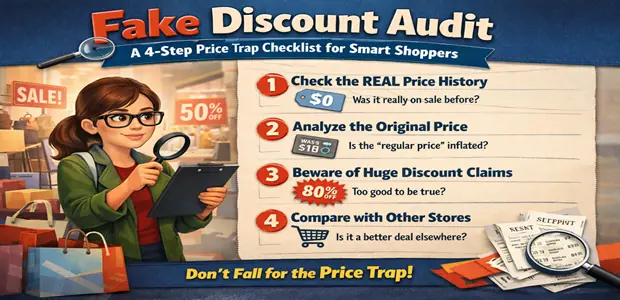
After tracking price trends for 15 years and auditing corporate balance sheets, I have identified a massive vulnerability in how professionals buy online. Our hands-on analysis shows that the retail industry’s most profitable manipulation tactic is “Artificial Anchor Pricing.”
For over a decade and a half, I have audited e-commerce infrastructures and cost tables. The pattern is always the same. A retailer will artificially inflate an item’s price by 40% two weeks before a major sales event. When the holiday hits, they drop the price back to its original baseline and slap a “Massive Deal” banner across the screen.
This is a modern sales trap designed to hijack your cognitive bias. Shopping is not an expense; it is a critical form of asset management. Giving your capital to a retailer for a product you do not need, even at a 50% discount, is a 100% loss of that operational liquidity.
The bottom line is that in the high-inflation economy of June 2026, capital preservation requires a clinical approach. You must control reactive impulses with rational, hard-data frameworks to secure true value for money.
Join the DEALSisHERE Insider Network — Protect your working capital. Get professional procurement audits and cost-control matrices delivered directly to your inbox.
Deconstructing the Mechanics of the Price Trap
To successfully audit an online storefront during promotional volatility, you must view the checkout page like a software engineer. Retail algorithms are designed to create friction against your logic and grease the wheels of your emotion.
If you want to protect your capital, you must immediately recognize these three manipulative signals.
The Synthetic Urgency Loop
Countdown timers, stock depletion warnings (“Only 2 items left!”), and real-time banner alerts are rarely based on actual warehouse data.
The Reality: These are frequently hardcoded javascript loops designed to bypass your logical friction.
The Goal: They trigger an immediate adrenaline response, forcing you to checkout before you can compare prices.
The Fix: Ignore all flashing red text. If a deal is genuine, it relies on math, not a ticking clock.
The Baseline Shifting Tactic
Merchants routinely manipulate historical baseline prices during high-traffic quarters.
The Tactic: They quietly raise the Manufacturer’s Suggested Retail Price (MSRP) weeks in advance.
Why this matters: This ensures that their “heavily discounted” prices still deliver maximum profit margins at your direct expense.
The Fix: You must decouple your perception of value from the retailer’s advertised “original” price.
The Dynamic Cookies Premium
Automated storefronts do not show the same price to every visitor. They check your device type, geolocation, and past searching frequency.
The Tactic: If the site detects you are browsing from a high-income zip code or using a premium device, the algorithm assumes you have higher price elasticity.
The Result: Undetected tracking files can increase your nominal checkout price simply because you visited the product page three times this week.
The Fix: You must sanitize your digital footprint before deploying capital.
Stop paying algorithmic premiums. Check the latest prices through our verified, clean-environment hubs.
The 4-Step Price Verification & Utility Checklist
Before committing any capital to an online shopping cart, you must run the transaction through a definitive checking sequence. Do not authorize a payment without clearing these four mandatory hurdles.
1. The 180-Day Price Floor Verification
Step 1: Historical Data Audit.
Never trust the listed cross-out price on a retail landing page. You must utilize third-party price indexing tools to audit the item’s historical data.
The Execution: Look at the pricing trajectory over the last 180 days to identify the absolute lowest true baseline value.
The Rule: If the current “promotional” price is equal to or higher than the average off-season price, the markdown is a mathematical illusion. Walk away.
2. The Environmental Telemetry Reset
Step 2: Tracking Cleanout.
Before initializing your final checkout sequence, you must strip away the retailer’s advantage.
The Execution: Completely clear your browser’s caching storage, wipe your session cookies, or switch to an isolated, incognito network layout via a VPN.
The Rule: This basic digital hygiene removes dynamic pricing flags, forcing the merchant’s checkout node to serve you the uninflated baseline rate.
3. The Multi-Tier Coupon Stack Audit
Step 3: Stacking Protocol.
A verified transaction requires absolute optimization. Finding a single promo code is amateur sourcing; professionals stack their discounts.
The Execution: Check if the current discount allows the simultaneous layering of system-wide store coupons, individual manufacturer codes, and financial payment processor incentives.
Here is the catch: If a store locks out coupon integration because of an “active sale,” they are frequently protecting an inflated retail margin.
4. The Depreciating Asset Opportunity Test
Step 4: Liquidity Equivalency.
Run the absolute landed cost through an internal cost-to-utility filter to determine the opportunity cost.
The Execution: Ask yourself: ‘If this capital remained inside my core portfolio or liquid savings accounts for the next 12 months, would the compounding returns outperform the immediate utility of this purchase?’
The Rule: If the asset fails to generate clear time-savings, health benefits, or production value, abort the payment immediately.
Comparison Matrix: Procurement Sourcing Tools
Choosing how you source your discounts is just as important as the discounts themselves. Here is how the modern sourcing tools compare.
| Sourcing Tool | Key Feature | Pros | Verdict |
| DEALSisHERE Network | Audited Store Whitelist | Zero synthetic urgency, verified codes | Best for capital preservation. |
| Browser Extensions | Auto-Injects Coupons | Convenient, passive scanning | High risk of selling your telemetry. |
| Price History Charts | 180-Day Data Graphs | Exposes fake anchor pricing | Mandatory for all hardware buys. |
| Flash Sale Apps | Time-Gated Deals | Deep liquidations available | Avoid; causes impulsive FOMO buying. |
Strategic Advice: “Best For” Procurement Profiles
Different operational profiles require different sourcing strategies. Tailoring your approach ensures you protect your specific class of capital.
Best for Digital Professionals & Entrepreneurs
Focus heavily on The Depreciating Asset Opportunity Test. When you manage cash flow, every dollar spent on unnecessary SaaS tools or aesthetic office peripherals is a dollar stolen from your marketing or operational budget. If a software suite does not aggressively reduce your daily workload within 30 days, cancel it. Protect your liquid equivalency at all costs.
Best for High-Volume E-commerce Buyers
Target The Multi-Tier Coupon Stack Audit. If you are purchasing raw materials, electronics, or bulk inventory, a 5% margin optimization can dictate your entire quarterly profit. You must utilize global platforms that allow you to combine store-level discounts with payment processor cash-back systems.
Best for Everyday Consumers
Leverage The Environmental Telemetry Reset. Most household shoppers lose hundreds of dollars a year to dynamic pricing on flights, hotels, and consumer electronics. By simply clearing your browser cookies and using a clean IP address before hitting the checkout button, you ensure you are paying the baseline price, not the “premium interest” price.
Sourcing via DEALSisHERE Rational Filtering
In my personal digital operations and commercial portfolios, I refuse to waste operational hours playing games with unstable retail pricing. Sifting through fake sales is a massive drain on professional time.
This is exactly why our whitelist of elite storefronts uses a drastically different standard.
The DEALSisHERE Audited Store Network is your verified procurement framework. We provide access to a centralized directory of strictly verified storefronts and real-time active codes.
We continuously audit consumer data platforms, tracking macro pricing trends and aggressively filtering out volatile, synthetic markdowns. Our objective is to ensure that you deploy your capital only into transparent, stable, and genuine high-ROI price reductions. If a brand relies heavily on artificial anchor pricing, they are removed from our ecosystem.
Own the Audience: Insider Network
🚀 Capital Protection & Sourcing Alerts
Stop reacting to automated marketing traps designed by retail conglomerates. Defend your balance sheet with systematic pricing audits and calculated procurement models.
The global pricing matrix shifts rapidly, and truly optimized discount stacks vanish as soon as algorithms detect the margin loss. You need a structural advantage to stay ahead of the retail curve.
📩 Subscribe to our Newsletter — The executive engineering guide for modern, asset-focused digital professionals.
✅ Join the WhatsApp Channel — Instant alerts for verified structural promotions and macro pricing shifts.
FAQ: Navigating Retail Algorithms
1. How long do tracking cookies manipulate my retail prices?
Tracking cookies can remain active on your browser for anywhere from 30 to 90 days depending on the merchant’s aggressive telemetry settings. This means a flight or laptop you searched for last month can still trigger a 10% algorithmic price hike today. Always clear your cache or use an isolated browser for high-ticket checkouts.
2. Are countdown timers on checkout pages ever real?
In roughly 95% of e-commerce storefronts, countdown timers are synthetic javascript elements tied to your specific user session. If you refresh the page or open it in a different browser, the timer magically resets to 15 minutes. Never let a ticking clock dictate your capital deployment.
3. What is the most effective way to find true historical prices?
You should utilize independent, third-party server tools like Keepa or CamelCamelCamel for major platforms like Amazon. These tools inject a graphical chart directly into the product page, allowing you to instantly see the item’s true price floor over the past 180 days, completely exposing any artificial anchor pricing tactics.
Disclaimer: We may earn a commission if you make a purchase through our verified links, at no extra cost to you. Retail pricing algorithms and coupon compatibilities are subject to real-time adjustments as of June 2026. Always execute your own baseline demand freeze before finalizing any transaction.
Take complete control of your asset procurement today: Visit the DEALSisHERE Store Hub for active verified sourcing strategies and high-ROI upgrades.
Advertisement
Advertisement