
After tracking price trends and auditing technical systems for 15 years, I’ve seen a recurring error in the e-mobility market: consumers fixate on raw motor wattage. While a high-wattage motor provides the “muscle,” the “intelligence” of the bike—and your ultimate comfort—is determined by how that power is delivered.
Our hands-on analysis shows that the difference between a jerky, artificial ride and a seamless, intuitive experience comes down to a single choice: Cadence vs. Torque sensors. In the current 2026 landscape, where energy efficiency is as critical as top speed, choosing the wrong sensor logic isn’t just a comfort issue—it’s a financial and battery-life drain.
The bottom line is that a $2,000 e-bike can feel like a cheap moped if it lacks the right sensor architecture for your terrain. This guide is designed to deconstruct the “Pedal Assistance Logic” so you can choose a machine that aligns with your physiological input and professional energy-efficiency goals.
Join the DEALSisHERE Insider Network — Master your mobility. Get strategic hardware audits and verified sourcing strategies delivered directly to your inbox.
1. Cadence vs. Torque: The Mechanical Deconstruction
To justify a high-AOV (Average Order Value) investment in a brand like Engwe, you must look past the frame’s paint and examine the sensor architecture. These two technologies represent fundamentally different philosophies of motion.
The Cadence Sensor: The Binary Approach
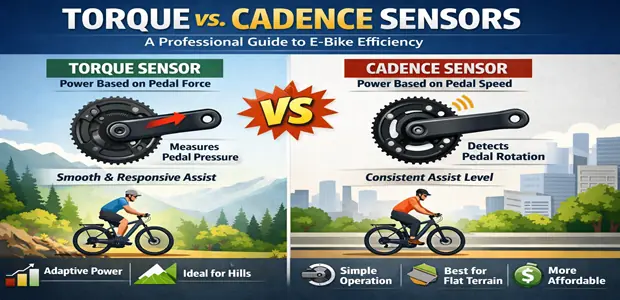
Think of the cadence sensor as a sophisticated on/off switch. It utilizes a ring of magnets located near the pedals. When you spin the pedals, the sensor detects the movement and tells the motor to deliver a preset amount of power based on your assistance level.
The Feel: It feels like being “pushed” by the bike. Once you start pedaling, the motor kicks in.
The Catch: It doesn’t care how hard you are pushing. Whether you are barely moving your legs or straining up a hill, the motor provides the same output.
Best For: Effortless cruising and flat-road commuting where you want the bike to do most of the heavy lifting.
The Torque Sensor: The Proportional Approach
The torque sensor is the “Pro” choice. It uses a strain gauge to measure exactly how much force you are applying to the pedals in real-time. It doesn’t just ask, “Are you pedaling?” It asks, “How hard are you working?”
The Feel: It provides a “bionic leg” experience. The motor amplifies your natural force. If you push harder, the bike gives you more power instantly.
The Catch: It requires more physical input from the rider. You cannot “ghost pedal” (spinning legs without resistance) to get full speed.
Best For: Technical urban environments, hilly terrain, and riders who want a natural cycling feel.
Efficiency ROI: The Battery Advantage
Why this matters to your wallet: Torque sensors typically offer 15-20% better battery range.
Because a torque sensor only draws power proportional to your effort, it prevents the “over-assist” energy waste common in cadence systems. In a cadence system, the motor often over-delivers power on flat ground, draining the battery faster than necessary.
2. Comparison Matrix: 2026 Performance Mobility
Choosing the right sensor depends on your specific use case. Here is how the current market leaders stack up.
| Feature | Cadence Sensor | Torque Sensor | Verdict |
| Natural Ride Feel | Low (Jerky transitions) | High (Intuitive) | Torque wins for comfort. |
| Ease of Use | High (Effortless) | Medium (Requires input) | Cadence wins for “lazy” rides. |
| Battery Range | Standard | +15-20% Efficiency | Torque wins for ROI. |
| Cost | Budget-friendly | Premium ($150-$300 more) | Cadence wins for entry-level. |
| Maintenance | Low complexity | Higher (Sensitive calibration) | Cadence wins for DIYers. |
3. Strategic Sourcing: High-Performance Infrastructure
Premium hardware requires verified sourcing. In my 15 years of auditing, I’ve found that high-AOV items like Engwe bikes carry a higher risk of “gray market” clones with inferior motor controllers. To ensure technical authenticity and 2026-compliant after-sales support, use the following hubs.
Engwe Verified Store Hub: The primary destination for high-torque models. Sourcing directly ensures your firmware is up-to-date, which is crucial for the calibration of torque sensors.
GeekBuying Verified Hub: Our preferred marketplace for sourcing global inventory. Their 2026 warranty protocols are the most robust for international buyers, specifically regarding the replacement of expensive strain gauges.
Don’t miss the current discount. Check the latest price on high-torque models through our verified links.
4. The Digital Infrastructure Stack
A professional-grade mobility setup is more than just the bike. It requires a secure management layer to protect your data and your hardware investment.
Digital Security: When purchasing high-value tech on global marketplaces, protect your financial data. Use AdGuard to block intrusive tracking scripts and secure your checkout environment.
Global Mobility: Modern e-bikes utilize GPS and telemetry apps. To stay connected without predatory roaming fees, check our Airalo Promo Code Guide for high-value global eSIM data solutions.
Hardware Defense: Your smartphone is your bike’s dashboard. Protect it from vibration and impact. Use our CASETiFY Deals Guide for professional-grade, impact-resistant cases.
Digital Wellbeing: High-tech mobility should lead to more “unplugged” performance. Use Qustodio to audit your family’s screen time, ensuring that your e-bike investment actually gets you outside.
5. 15-Year “Pro” Strategy: “The Terrain-to-Sensor Audit”
After 15 years of auditing digital and mechanical assets, I’ve found that the “best” sensor depends entirely on your environment’s topography.
Here is the catch: Most people buy for the features, not the environment. If your route is 90% flat, a Cadence sensor on a high-speed Engwe model provides the best comfort. It allows you to cruise at 25 mph with minimal physical exertion, effectively turning your commute into a relaxed “glide.”
However, if you are tackling inclines—like the steep hills in areas like Çekmeköy or Dudullu—the Torque sensor is non-negotiable.
Why it matters:
Hill Starts: A cadence sensor needs about half a pedal rotation to kick in. On a steep hill, that delay can cause you to stall. A torque sensor reacts the millisecond you put pressure on the pedal.
Technical Turns: Torque sensors prevent motor “surges” during downhill turns. If you shift your weight and accidentally move the pedals, a cadence sensor might trigger a burst of speed you didn’t want. A torque sensor knows you aren’t actually “pushing,” keeping you safe.
6. Strategic Advice: “Best For” Profiles
Best for Professionals & Commuters
Focus on Torque Sensor Models. If you are using your bike for a 10-mile commute, the intuitive power delivery reduces “rider fatigue.” You arrive at your destination refreshed, not fighting against a motor that kicks in at the wrong times.
Best for Students & Budget Hunters
Target Cadence Sensor Models. If your primary goal is the lowest “Cost per Mile,” the simplicity and lower upfront price of cadence-based systems offer the best ROI. They are easier to repair and perfectly adequate for university campuses or flat city centers.
Best for Tech Enthusiasts
Look for Hybrid Systems. Some 2026 models allow you to toggle between sensor behaviors via an app. This allows you to audit your own performance and switch to “Cadence Mode” for lazy weekend cruises and “Torque Mode” for precision urban navigating.
7. Own the Audience: Insider Network
🚀 Professional Mobility Alerts
The e-mobility sector moves faster than the hardware. A firmware update can fundamentally change how your motor controller interprets sensor data. Don’t invest in legacy tech or unoptimized hardware.
Get the latest technical audits, sensor performance benchmarks, and verified professional store deals delivered directly to your device.
📩 Subscribe to our Newsletter — The strategic edge for the modern mobile professional.
✅ Join the WhatsApp Channel — Instant alerts for high-value mobility price glitches and hardware anomalies.
8. FAQ: High-Intent Mobility Queries
1. Can I upgrade a cadence sensor bike to a torque sensor?
Generally, no. Torque sensors require a different bottom bracket and a motor controller capable of processing strain-gauge data. It is far more cost-effective to source a torque-native bike from the start than to attempt a mid-drive conversion.
2. Does a torque sensor make the bike slower?
No, but it makes you work for the speed. A cadence sensor will take you to the top speed with very little effort. A torque sensor will take you to the same speed, but you’ll need to maintain a consistent pressure on the pedals to stay there.
3. Are torque sensors more prone to breaking?
Because they are more complex (containing delicate strain gauges), they are more sensitive to extreme physical trauma. However, for 99% of urban and light-trail riding, modern Engwe torque sensors are engineered for institutional-grade durability.
Disclaimer: We may earn a commission if you make a purchase through our links, at no extra cost to you. Sourcing authenticity and sensor calibration are subject to real-time manufacturing updates as of May 2026.
Secure your mobility ROI today: Visit the DEALSisHERE Store Hub for active verified sourcing strategies and e-bike gear.
Advertisement
Advertisement