
After tracking price trends and auditing consumer tech infrastructure for 15 years, I have uncovered a glaring blind spot in the micro-mobility market. Buyers will spend thousands on a premium e-bike, only to destroy its core engine through sheer negligence.
Today, on May 4, 2026, the modern electric bike is a sophisticated piece of digital hardware. Yet, the biggest mistake I see in electric bike battery maintenance is treating the power unit like a simple “gas tank.”
Our hands-on analysis shows that a battery is essentially a living chemical organism. It breathes, it reacts to temperature, and it degrades when stressed. Poor charging habits can cripple a powerful Engwe e-bike, dropping its maximum range by 30% in just 12 months.
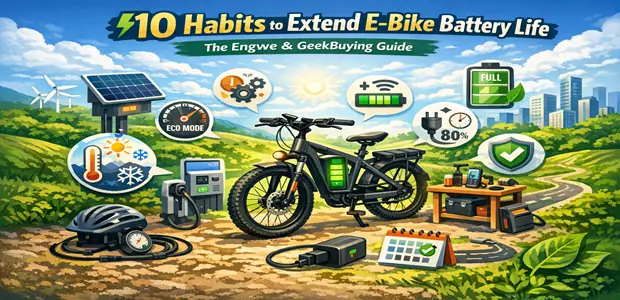
In this evergreen guide, we are deconstructing the exact protocols that separate professional “performance auditors” from casual riders. By mastering these 10 e-bike battery longevity habits, you will protect your investment and secure maximum mileage for years to come.
Join the DEALSisHERE Insider Network — Master your tech. Get strategic maintenance audits and verified equipment deals delivered directly to your inbox.
1. The 10 Habits of Battery Mastery
Most riders plug their bike in, walk away, and hope for the best. That is not a strategy; it is a gamble.
To maximize the ROI on your electric transit, you must adopt a strict operational protocol. Here are the 10 habits you need to implement today.
Habit 1: The 20-80 Rule (Avoid Deep Discharge)
Lithium-ion cells thrive in the middle of their voltage range. Pushing them to the absolute limits causes severe microscopic wear.
The Mistake: Riding the bike until the display flashes 0%, then plugging it in until it sits at 100% for days.
The Science: Deep discharges force the cells into a low-voltage state that physically degrades the cathode.
The Pro-Fix: Keep your battery between 20% and 80% for daily commuting. Only charge to 100% when you strictly need the maximum range for a long trip. This simple habit can literally double your total cycle life.
Habit 2: The “Cool Down” Protocol
Your battery generates massive internal heat during a ride. Subjecting it to immediate charging compounds that thermal stress.
The Mistake: Pulling into your garage after a high-torque hill climb and instantly plugging the charger into the port.
The Science: Charging a hot battery accelerates lithium plating, a condition where lithium metal builds up inside the cell, permanently killing capacity.
The Pro-Fix: Never charge immediately after a ride. Let the cells stabilize at room temperature for at least 30 to 45 minutes before introducing a charging current.
Habit 3: Correct Sequence Charging
There is a mathematically correct order to connecting your power supply, designed to protect the delicate Battery Management System (BMS).
The Mistake: Plugging the charger into the wall first, and then jabbing the live cable into your expensive battery.
The Science: A live charger holds excess voltage in its capacitors. Connecting it to the battery second can cause a micro-arc (a small spark) that degrades the connection pins over time.
The Pro-Fix: Always plug the DC connector into the battery first. Once it is securely seated, plug the AC cord into the wall outlet.
Habit 4: Temperature Arbitrage
Lithium cells are incredibly sensitive to ambient temperatures. Treat your battery like a houseplant.
The Mistake: Leaving your e-bike locked outside in the freezing snow or baking in the trunk of a hot car during the summer.
The Science: Heat above 30°C (86°F) accelerates chemical aging. Cold below freezing artificially restricts the flow of electrons, severely limiting your range.
The Pro-Fix: Store and charge your battery in a temperate zone, ideally between 15°C and 25°C. If you must park outside in the winter, remove the battery and bring it indoors with you.
Habit 5: The 50% Storage Sweet-Spot
There will be seasons where you do not ride. How you put your battery to “sleep” dictates how it will wake up.
The Mistake: Leaving the battery at 100% charge in the garage all winter, or worse, leaving it completely dead at 0%.
The Science: A battery stored at 100% is highly pressurized, causing capacity fade. A battery stored at 0% can fall into a “deep sleep” where the BMS permanently bricks the unit for safety.
The Pro-Fix: If storing your bike for more than two weeks, keep the charge at roughly 40-60%. Check it once a month and top it up slightly if it drops below 40%.
Habit 6: Avoid “Overnight Bloat”
Convenience often comes at the cost of hardware health. Leaving your bike plugged in overnight is a slow killer.
The Mistake: Plugging the bike in at 8:00 PM and unplugging it at 7:00 AM the next day.
The Science: While the BMS stops the main charge at 100%, the charger often continues to “trickle charge” to compensate for tiny voltage drops. This holds the cells at maximum stress for hours.
The Pro-Fix: Unplug the charger as soon as the LED indicator turns green. If you charge at night, use a cheap outlet timer set to cut the power after 4 hours.
Habit 7: Originality in Power
Third-party chargers are a false economy. Saving $20 on a generic charger can cost you a $400 battery pack.
The Mistake: Buying an off-brand “fast charger” from a random marketplace seller to speed up your turnaround time.
The Science: Authentic chargers are calibrated to the exact voltage curve of your specific BMS. Generic chargers often mismatch the voltage, pushing too much current at the top of the charge cycle.
The Pro-Fix: Only use the official power brick provided by Engwe. If you need a spare for the office, source an authentic replacement directly from a verified hub.
Habit 8: Tire Pressure ROI
Your battery’s health isn’t just about chemistry; it’s about physics. Mechanical drag drains your cells.
The Mistake: Riding on under-inflated, squishy fat tires because you haven’t checked the PSI in three months.
The Science: Low tire pressure drastically increases rolling resistance. This forces the hub motor to draw significantly more continuous amperage from the battery to maintain speed.
The Pro-Fix: Check your tire pressure weekly. Keeping tires at their optimal PSI reduces the amp draw, lowering internal battery heat and extending your range per charge.
Habit 9: The Contact Audit
Power cannot flow efficiently through dirt. Your maintenance routine must include the physical connection points.
The Mistake: Riding through mud, rain, and dust, and never cleaning the battery cradle or connection prongs.
The Science: Dust and moisture build-up create micro-resistance. Resistance generates heat at the terminal, causing voltage drops and potential micro-corrosion.
The Pro-Fix: Once a month, remove the battery and wipe the terminals with a dry, clean microfiber cloth. Ensure the cradle is free of debris before locking the unit back in.
Habit 10: Throttle Discipline
The way you ride directly impacts the lifespan of the lithium cells. Aggressive riding equals aggressive degradation.
The Mistake: Mashing the throttle to 100% from a dead stop at every single traffic light.
The Science: Instant, full-throttle acceleration pulls massive “current spikes” from the battery. These spikes generate sudden bursts of internal heat, stressing the cell walls.
The Pro-Fix: Use pedal-assist to get the bike rolling from a dead stop, then roll onto the throttle smoothly. Smooth acceleration flattens the amp draw, protecting your hardware.
Protect your investment: Check the latest Engwe gear and verified replacement parts here.
2. Comparison Matrix: Sourcing & After-Sales Support
When it comes to high-value e-mobility, where you buy dictates the support you receive.
| Sourcing Channel | Key Feature | Pros | Verdict |
| Engwe Verified Hub | Direct Manufacturer Access | Genuine parts, official warranty tracking | Best for Long-Term Security. |
| GeekBuying Hub | Global Warehousing | Faster shipping, robust after-sales platform | Best for Rapid Sourcing. |
| Generic Marketplaces | Lowest Upfront Price | High risk of refurbished or cloned cells | Avoid for Primary Hardware. |
| Used Market | Extreme Depreciation | Cheap entry point | High Risk; batteries are unpredictable. |
3. Strategic Sourcing: Where to Buy Genuine Gear
To ensure your investment is protected, you must source your hardware through channels that offer verified support. The e-bike market is flooded with counterfeit cells and gray-market inventory.
The bottom line is that a cheap battery clone is a severe fire hazard. Professional sourcing mitigates this risk entirely.
Engwe Verified Store Hub: This is your direct source for official parts, genuine replacement batteries, and long-term warranty protection. When you source directly, your serial number is logged in the official database.
GeekBuying Verified Hub: GeekBuying is our preferred marketplace for global availability. They maintain local warehouses across the EU and US, offering reliable after-sales support and authentic inventory without the cross-border shipping delays.
👉 Access the Verified GeekBuying Promo Hub Here
4. Strategic Advice: “Best For” Sections
Different riders require different strategic approaches to battery management. Identify your profile to optimize your workflow.
Best for Urban Commuters
Focus heavily on the 20-80 Rule and Overnight Bloat Avoidance. If you commute 5 miles a day, you do not need a 100% charge. Keep your battery in the mid-range and use an outlet timer to ensure you never over-stress the cells during the workweek.
Best for Delivery Professionals
Focus on Throttle Discipline and Tire Pressure ROI. When you are on the bike for 6 hours a day, mechanical drag and amp spikes are your biggest enemies. Smooth riding and rock-hard tires will maximize your daily delivery range and preserve the battery’s overall lifespan.
Best for Weekend Trail Riders
Focus on the Cool Down Protocol and The Contact Audit. Off-road riding pushes the motor to its thermal limits and covers the bike in dust. You must let the battery cool before charging, and you must wipe down the terminals after every muddy trail session.
5. 15-Year “Pro” Strategy: “The Warranty Audit”
In my 15 years of auditing consumer tech, I’ve found that companies like GeekBuying and Engwe provide incredible ROI—but only if you speak their language during a support claim.
Customer service agents are trained to look for user negligence. If your battery fails, you need to prove you were an auditor, not an abuser.
How to Bulletproof Your Warranty:
Start a Maintenance Log: The day you unbox your bike, start a simple digital note.
Document the Setup: Take photos of your charging station. Ensure it shows a clean, temperature-controlled environment away from direct sunlight.
Record the 20-80 Rule: Keep a brief log of your charging cycles.
Why this matters: If you ever need to claim after-sales support, submitting a structured “Maintenance Log” alongside your ticket changes the entire dynamic. It proves to the vendor that the failure is a manufacturing defect, making the warranty replacement process utterly seamless.
6. Own the Audience
🚀 Performance Mobility Alerts
The micro-mobility landscape is evolving rapidly. High-capacity battery tech and smart BMS firmware updates are changing how we manage our digital transit. Don’t let your gear degrade because you missed a critical maintenance shift.
Get the latest technical audits, firmware updates, and verified equipment deals delivered straight to your pocket.
✅ Join the WhatsApp Channel — Instant alerts for flash sales on genuine replacement parts.
📩 Subscribe to our Newsletter — The strategic edge for the modern mobile professional.
7. FAQ: E-Bike Battery Mastery
1. Can I leave my Engwe battery on the bike in the winter?
Absolutely not. If your storage area drops below 10°C (50°F), you must unlock the battery and bring it inside. Freezing temperatures drastically increase internal resistance and can permanently damage the cell chemistry if left for prolonged periods.
2. How do I know if my e-bike battery is dying?
Look for “Voltage Sag.” If you charge to 100%, and simply twisting the throttle causes the display to instantly drop to 80% before bouncing back up, your battery is suffering from high internal resistance. This is the primary indicator of a degraded pack.
3. Is it safe to charge my battery immediately after a cold winter ride?
No. This is actually more dangerous than charging a hot battery. Charging lithium cells while they are below freezing causes irreversible lithium plating, which destroys capacity and creates a severe safety hazard. Let the battery warm up to room temperature inside your house before plugging it in.
Disclaimer: We may earn a commission if you make a purchase through our verified sourcing links, at no extra cost to you. Always consult your specific Engwe user manual, as BMS firmwares and hardware specifications are subject to updates.
Secure your mobility investment: Visit the DEALSisHERE Store Hub for active verified sourcing strategies and gear.
Advertisement
Advertisement