
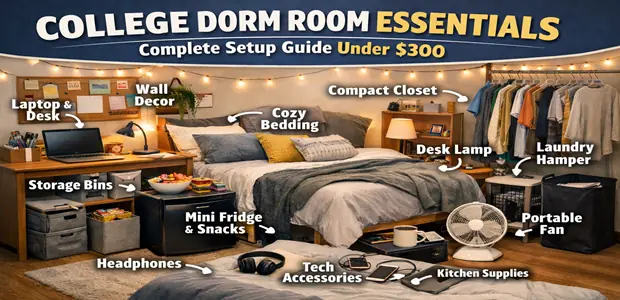
By the DEALSisHERE Senior Shopping & Consumer Technology Team | Last Updated: June 27, 2026
Setting up college dorm room essentials on a tight budget is one of the most common — and most easily botched — shopping challenges students face. The temptation to fill a small space with aesthetically appealing items is real, and retailers know it. The result is a room that looks good in a haul video but functions poorly by week three of the semester.
This guide takes a different approach. We’ve mapped out a $300 budget across three functional categories — sleep, storage, and power — and identified the specific products that deliver the highest long-term value within each. No filler. No decor for decor’s sake. Just what actually makes dorm life functional.
📩 Join the DEALSisHERE Insider Network — Protect your student budget from retail traps. Get verified pricing analytics, structural buying frameworks, and real-time discount codes delivered straight to your inbox. Subscribe Now →
Quick Recommendations
If you’re short on time, here’s where to start:
- Best sleep investment: Twin XL mattress pad + microfiber sheet set combo
- Best ergonomic upgrade: High-density memory foam pillow
- Best space multiplier: 3-tier rolling mesh utility cart
- Best closet upgrade: Heavy-duty hanging closet organizers
- Best power solution: Surge protector with multi-USB ports (UL certified)
- Best study light: Clip-on LED desk/bed reading light
- Most underrated buy: 10ft braided charging cables (×2)
The $300 Budget Framework: How to Allocate It
Before the product breakdowns, here’s the allocation logic:
| Category | Budget Target | What It Covers |
|---|---|---|
| Sleep & Comfort | ~$110 | Mattress pad, sheets, pillow |
| Storage & Space | ~$100 | Rolling cart, closet organizers, laundry hamper |
| Power & Digital | ~$90 | Surge protector, LED light, charging cables |
| Total | ~$300 | Full functional dorm setup |
This isn’t arbitrary. Sleep quality directly affects academic performance. Storage determines whether a 120 sq ft room stays functional or becomes chaotic. Power infrastructure protects your devices and keeps everything charged. Everything else — rugs, string lights, decorative pillows — is optional and should only be purchased after these three tiers are fully funded.
Comparison Matrix
| Product | Best For | Key Strength | Potential Drawback | Verdict |
|---|---|---|---|---|
| Twin XL Mattress Pad | Anyone using a dorm mattress | Instantly improves mattress comfort + hygiene barrier | Adds bulk when packing/moving | Essential — buy first |
| Memory Foam Pillow | Students with neck discomfort or poor sleep | Ergonomic support, washable cover | Higher upfront cost than basic pillow | Worth the premium |
| 3-Tier Rolling Cart | Small rooms needing flexible storage | Portable, modular, multi-purpose | Wheels can scratch some floors | Top space investment |
| Hanging Closet Organizer | Students with limited drawer space | Doubles closet capacity, no assembly | Fabric can sag under heavy load | High-value upgrade |
| Surge Protector (UL) | Everyone | Protects devices + solves outlet scarcity | Bulkier than standard power strip | Non-negotiable buy |
| Clip-on LED Light | Night-owl students with roommates | Directional light, roommate-friendly | Battery models need recharging | Practical and low-cost |
| 10ft Braided Cables | Anyone frustrated by cable length | Reach anywhere in the room | Braided cables are stiffer than standard | Immediate quality-of-life upgrade |
Individual Product Reviews
Twin XL Mattress Pad & Microfiber Sheet Set
Overview
Dorm mattresses are, almost without exception, uncomfortable and of questionable cleanliness. A quilted or memory foam mattress pad addresses both issues: it adds a comfort layer on top of the institutional mattress and creates a washable hygiene barrier between you and whatever lived there before you.
Pair the mattress pad with a microfiber sheet set in Twin XL sizing. Standard Twin sheets don’t fit dorm mattresses properly — this is a detail that catches first-year students off guard every September.
Pros
- Immediately improves sleep surface quality without buying a new mattress
- Washable — creates a hygiene barrier over the dorm mattress
- Microfiber sheets are durable, soft, and dry quickly in shared laundry facilities
- Twin XL sizing fits virtually all US dorm beds
Cons
- Adds volume when packing up at end of semester
- Higher loft mattress pads can make fitted sheets pop off overnight
- Not a substitute for a genuinely supportive mattress if you have serious back issues
Best For
Every incoming student. There is no scenario where a mattress pad is a bad investment for a dorm room.
Why We Recommend It
Sleep quality is one of the most underestimated variables in academic performance. A $35–$50 mattress pad that improves your sleep by even 15–20% delivers a return that no aesthetic item can match. Buy the best mattress pad your category budget allows, then work down the list.
High-Density Memory Foam Pillow
Overview
Standard dorm-supplied pillows (in schools that provide them) or entry-level pillows from discount stores tend to compress within weeks and offer minimal neck support. A high-density memory foam pillow maintains its loft and alignment over a full academic year and beyond.
Look for a pillow with a removable, machine-washable cover — non-negotiable for shared laundry environments.
Pros
- Maintains shape and support throughout the year
- Washable cover keeps it hygienic in shared living environments
- Reduces neck stiffness and morning fatigue
- Most memory foam options come with a multi-year warranty
Cons
- Higher initial cost than a standard pillow ($30–$55 vs. $8–$15)
- Memory foam sleeps warmer than alternatives — a consideration in poorly air-conditioned dorms
- Heavier to transport
Best For
Students who wake up stiff, sleep on their side, or have had neck issues in the past.
Why We Recommend It
The quality gap between a memory foam pillow and a discount pillow is genuinely significant and felt every single morning. Over a 9-month academic year, that daily difference in sleep quality makes it one of the highest-ROI items in this entire guide.
👉 Secure Premium Sleep Infrastructure on Amazon → Twin XL mattress pads, microfiber sheet sets, and memory foam pillows — all within the $110 category budget.
3-Tier Rolling Mesh Utility Cart
Overview
A rolling mesh utility cart is one of the most versatile objects you can put in a dorm room. It functions as a bedside table, a desk organizer, a bathroom caddy for shower trips, a kitchen cart, and a mobile storage unit that can be repositioned as needed. In a 120 sq ft room shared with another person, that flexibility is genuinely valuable.
Steel mesh construction is preferable to plastic — more durable, better airflow, and more stable under load.
Pros
- Portable: rolls wherever you need it, including to the bathroom
- Three tiers means meaningful storage capacity in minimal floor space
- Modular — works differently depending on what you need that week
- Steel mesh versions are durable enough to last multiple years
Cons
- Wheels can leave marks on certain vinyl or wood-look dorm floors — check your school’s flooring
- Doesn’t replace fixed shelving for heavier items
- Assembly required (typically 15–20 minutes)
Best For
Students with limited desk space, no nightstand, or who want a single storage solution that serves multiple functions.
Why We Recommend It
At $35–$50, a rolling cart delivers more functional value per dollar than almost any other item in this guide. It solves three separate storage problems simultaneously and moves with you across rooms and apartment upgrades in subsequent years.
Heavy-Duty Hanging Closet Organizer
Overview
Dorm closets are almost always inadequate — a single hanging rod and a shelf, often shared. A hanging closet organizer with multiple compartments and a shelf unit effectively doubles usable closet space without requiring any installation or tools.
Look for reinforced stitching and metal bar construction rather than flimsy plastic hooks, which bend under load.
Pros
- Doubles closet storage capacity immediately
- No tools or installation required
- Reinforced versions handle significant load without sagging
- Costs $15–$25 — high value for the space gain
Cons
- Fabric versions can sag over time if overloaded
- Takes up hanging rod space — less room for long garments
- Quality varies significantly between products; read reviews carefully
Best For
Students bringing more clothes than their closet can realistically handle, which is most students.
Why We Recommend It
It’s one of the cheapest, highest-impact purchases on this list. The closet space problem in dorm rooms is universal. This is the most direct solution at the lowest cost.
Collapsible Mesh Laundry Hamper
Overview
You need somewhere to put dirty laundry. A collapsible mesh hamper folds flat when empty, takes up minimal space, and the mesh construction allows airflow that reduces odor buildup. Not glamorous. Genuinely necessary.
Pros
- Collapses to near-zero volume when empty
- Mesh construction reduces odor
- Lightweight and portable for laundry room trips
- Inexpensive ($10–$20)
Cons
- Mesh doesn’t contain fine debris (sand, crumbs) as well as solid-sided hampers
- Collapsible versions can tip when partially full
Best For
Everyone. This is a utility purchase with no meaningful trade-offs at the price point.
Why We Recommend It
The only decision here is size. If you do laundry weekly, a standard capacity hamper is fine. If your laundry habits are more intermittent, size up.
👉 Secure Space Optimization Modules on Amazon → Rolling utility carts, hanging closet organizers, and collapsible laundry hampers — all within the $100 category budget.
Surge Protector Power Strip with Multi-USB Ports (UL Certified)
Overview
Dorm rooms were not designed for the power demands of modern students. Two wall outlets shared between two people running laptops, monitors, phones, tablets, desk lamps, fans, and chargers is a genuine infrastructure problem.
A UL-certified surge protector with 6–8 AC outlets and 4+ USB ports solves this immediately while protecting your devices against voltage spikes. The UL certification is non-negotiable — it means the unit has been independently tested for safety.
Pros
- Solves the outlet scarcity problem completely
- Surge protection guards against voltage spikes that can damage laptops and phones
- USB ports mean fewer wall adapters needed
- UL-certified models are genuinely safe; uncertified units are a fire risk
Cons
- Bulkier than a basic power strip
- Some dorms have policies against certain power strip configurations — check your school’s policy before buying
- Premium models with USB-C Power Delivery cost more (~$35–$50 vs. $20–$30 for basic)
Best For
Every student. This is the most safety-critical purchase on the list.
Why We Recommend It
A $30 surge protector can prevent a $1,200 laptop from being destroyed by a voltage spike. The math is straightforward. Buy a UL-certified unit, not the cheapest unit available.
Clip-on LED Desk/Bed Reading Light
Overview
Studying late while your roommate is asleep is a near-universal dorm experience. A clip-on LED reading light with adjustable brightness and color temperature lets you work without disturbing them. Look for a USB-powered model so you’re not burning through batteries.
Pros
- Directional light keeps brightness contained to your area
- USB-powered versions are economical to run
- Clip mount works on headboards, desk edges, shelves, and monitors
- Adjustable brightness and color temperature options on better models
Cons
- Very basic models have limited brightness that may strain eyes during extended sessions
- Cable can feel restrictive if your outlet placement is inconvenient
- Not a substitute for a proper desk lamp if you’re doing detailed work
Best For
Students who study or read after their roommate goes to sleep.
Why We Recommend It
At $12–$20, it’s one of the lowest-cost items on this list with a direct, immediate impact on daily life. The alternative — turning on the overhead light at midnight — is a fast track to roommate conflict.
Extra-Long 10ft Braided Charging Cables
Overview
Standard charging cables are approximately 3 feet long. Dorm rooms are not designed around where you’d actually like to sit while your phone charges. A 10ft braided cable lets you charge your phone from bed, desk, or couch without being tethered to the outlet.
Braided nylon cables are significantly more durable than standard plastic-coated cables and resist the tangling and fraying that kills standard cables within a few months.
Pros
- 10ft length eliminates the “my phone is stuck next to the outlet” problem
- Braided nylon construction is genuinely more durable than standard cables
- Available in USB-C, Lightning, and multi-connector versions
- Inexpensive: $10–$18 each
Cons
- Braided cables are stiffer and less flexible than standard cables
- Longer cable means more cable to manage if you’re tidy-minded
- Verify compatibility (USB-C to USB-C, USB-A to USB-C, etc.) before ordering
Best For
Everyone — this is a quality-of-life upgrade with no real downside.
Why We Recommend It
Buy two. One for the desk, one for the bedside. At $10–$18 each, it’s the cheapest meaningful upgrade on the list.
👉 Secure Digital Infrastructure on Amazon → UL-certified surge protectors, clip-on LED lights, and braided charging cables — all within the $90 category budget.
Buying Guide: What Actually Matters
Prioritize Function Over Aesthetics
The retail environment around “dorm room shopping” is aggressively aesthetic. Matching color palettes, decorative storage, novelty lighting. Most of it is low-durability items designed to look good in photos and degrade within a semester.
The functional items in this guide — mattress pad, rolling cart, surge protector — will still be working in your junior year apartment. The decorative throw pillow probably won’t.
Fund function first. Add aesthetics with whatever remains.
The 24-Hour Cart Rule
When you’ve built your Amazon cart, don’t check out immediately. Wait 24 hours. The items that still feel necessary after the excitement fades are the right ones. The impulse additions that felt urgent yesterday — those are what you’re filtering out.
This single habit is the most reliable budget protection tool available for any shopping session.
Common Mistakes Students Make
1. Buying Twin instead of Twin XL bedding. Most US dorms use Twin XL mattresses. Standard Twin sheets won’t fit. Check your school’s mattress dimensions before ordering.
2. Choosing an uncertified power strip to save $8. Non-UL-certified surge protectors are a documented fire risk. The safety savings on a certified unit are not worth compromising.
3. Overbuying storage before seeing the room. Every dorm room is different. If possible, see the room (in person or via photos) before buying storage solutions. What works in one layout may be redundant in another.
4. Spending the decor budget before the function budget. String lights and matching organizers are satisfying to buy. A good mattress pad is not exciting to buy. Buy the mattress pad first.
5. Ignoring roommate logistics. If you have an assigned roommate, coordinate on shared items (mini-fridge, microwave, TV) before arriving so you don’t end up with duplicate large appliances.
Long-Term Value
The items in this guide are chosen specifically for durability across multiple years. A quality rolling cart, surge protector, and memory foam pillow will follow you from the dorm to an off-campus apartment without needing replacement. This compounds the value significantly — you’re not buying dorm items, you’re buying items that start in the dorm and serve you for 3–4 years.
📦 Amazon Daily Verified Promo Codes → — Cross-reference your dorm checklist against active merchant promo codes and real-time price drops to compress your total spend below the $300 ceiling.
Frequently Asked Questions
Q: Do I really need a mattress pad, or will the dorm mattress be fine?
Most students who skip the mattress pad regret it. Dorm mattresses are typically firm, plastic-covered, and of uncertain age. A mattress pad adds comfort and creates a washable hygiene layer. At $30–$50, it’s one of the highest-value purchases in the entire guide.
Q: What’s the difference between a surge protector and a regular power strip?
A regular power strip distributes power from one outlet to multiple outlets but offers no protection against voltage spikes. A surge protector includes circuitry that absorbs or redirects voltage spikes before they reach your devices. For a dorm room with a laptop and phone, the surge protection is worth the small price difference. Look for UL certification.
Q: Will my school allow all of these items?
Most schools permit everything on this list, but power strip policies vary. Some schools require UL-certified units specifically. A small number prohibit multi-outlet devices above a certain number of outlets. Check your school’s housing handbook before ordering the surge protector specifically.
Q: Can I realistically do this under $300?
Yes — the budget allocation adds up to approximately $300 at mid-range price points for each item. You can come in under $300 by selecting store-brand or off-brand options in the lower-risk categories (laundry hamper, closet organizer, charging cables) while spending closer to the category ceiling on the sleep layer and surge protector.
Q: What should I absolutely not buy for my dorm room?
Full-length floor mirrors (takes too much space), a desk chair (dorms provide one), a coffee maker before you know if the dorm allows it, and any item described as “aesthetic” or “trendy” that doesn’t have a clear functional purpose. These are the categories that blow student budgets with the lowest return.
Final Verdict
A functional, well-organized dorm room on a $300 budget is entirely achievable. The framework is simple: fund sleep first, storage second, power third. Every other purchase is optional and should only happen after these three tiers are complete.
The items in this guide were selected for durability, multi-year utility, and honest value at their price points. None of them are the most exciting purchases you’ll make this year. All of them will make your day-to-day life in a small shared space noticeably more functional.
Shop from a list. Apply the 24-hour cart hold. And don’t let the aesthetic dorm content on social media redirect your budget away from the things that actually matter.
🚀 High-Velocity Capital Preservation & Sourcing Alerts
Stop allowing retail algorithms to blow your student budget on low-durability aesthetic items:
📩 Subscribe to the DEALSisHERE Newsletter → — Strategic procurement and sourcing guides for asset-focused students and digital professionals.
Affiliate Disclaimer: We may earn a commission if you make a purchase through our links, at no extra cost to you. This never influences our editorial recommendations — products are selected independently based on functional value and long-term durability.
Advertisement
Advertisement